



May 11, 2023 |
GSAM Connect


In The Spotlight
In The Spotlight
In The Spotlight
Stay on top of the latest market developments, key themes, and investment ideas affecting your portfolio and practices.
Explore how we can help you
Contact UsJune 8, 2023 | 5 Minute Read

David AlterHead of Municipal Credit Research, Municipal Fixed Income David Alter |
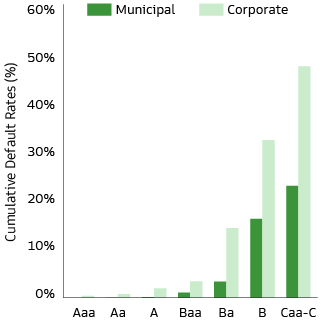
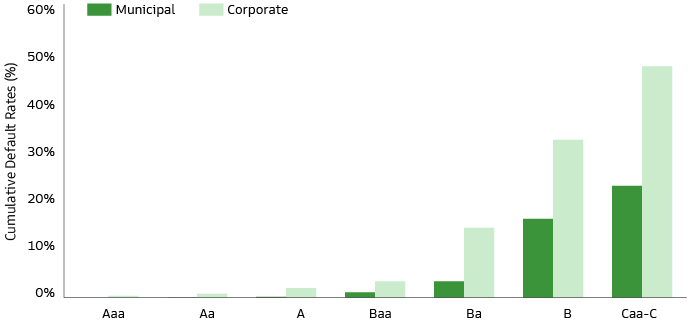
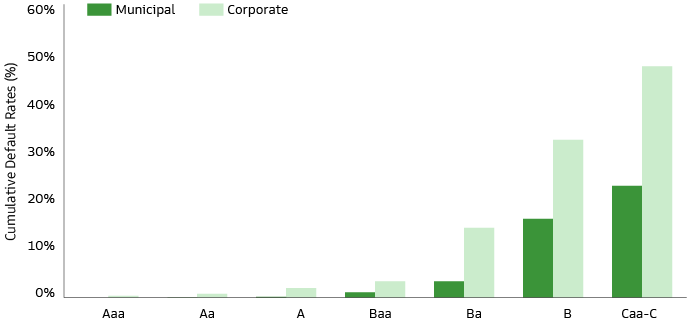
Inherent in all cycles is that the best of times do not last forever. The current muni credit cycle is no different—resembling economic cycles before, revenue expansion will likely moderate just when expenses remain elevated. Unlike corporations, municipalities are typically less nimble, or incentivized, to immediately cut spending. Often states and local governments have mandated expenses that aren’t easily slowed or reversed, and sometimes the political environment also contributes to elevated spending. Despite these challenges we believe municipal credit is far more stable than similarly rated corporate credit (Exhibit 1).
Source: Moody’s Investors Service, “US Municipal Bond Defaults and Recoveries.” As of April 2022.
Regardless of the driver, we know from the past that these cycles are consistent, and that fundamental municipal credit has remained stable through the cycle. Importantly we consider credit quality through the “life cycle” and with great revenue diversity and budgetary autonomy, municipal credit quality tends to remain in a very tight band throughout a cycle. That said, across the vastness of the muni market we do expect rating trends to change—on the margins—with a potentially weakening economy. Year-to-date upgrades have outpaced downgrades by a wide margin, and we believe this trend is starting to moderate.
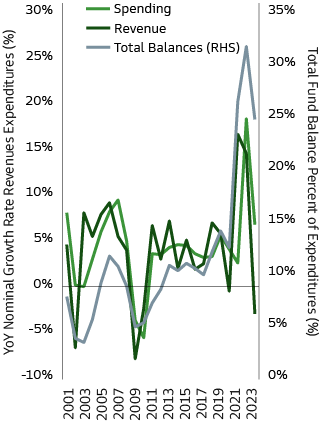
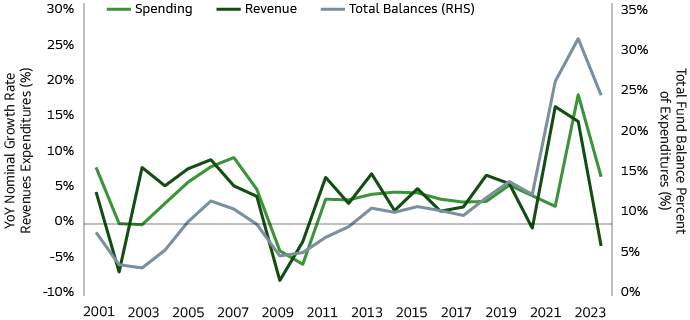
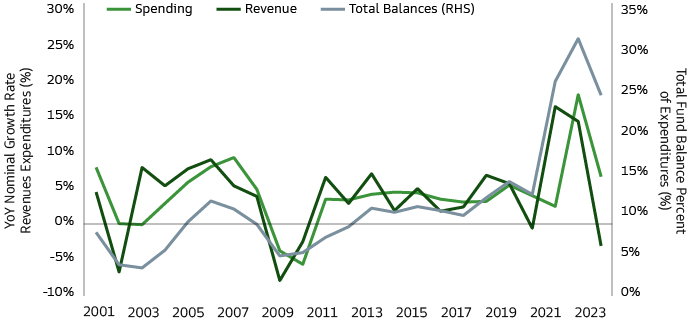
We believe that the leading edge of the change in the cycle is underway. Our Municipal Fixed Income 2023 Outlook suggested that the credit environment would start turning in the latter part of 2023. Revenue data for some major issuers are showing some signs of weakness. Most states and larger local governments are in the middle to late stages of their fiscal 2024 budgets and officials are laser-focused on current revenue performance as they forecast for the next year. The National Association of the State Budget Officers (NASBO) graph (Exhibit 2) shows the decline in revenue growth while expenses are forecast to continue to grow, albeit at a slower pace.
The good news is that, unlike leading up to the Great Recession, governments are sitting on a record war chest of liquidity, with rainy day funds hitting all-time highs in 37 states by the end of the 2022 fiscal year. Robust economic expansion in the last decade alongside enhanced federal aid during the depths of COVID-19, have resulted in reserve levels that the industry has never experienced, equal to about 30% of spending (Exhibit 2, grey line).
Source: National Association of State Budget Officers (NASBO), Spring 2022. The economic and market forecasts presented herein are for informational purposes as of the date of this web page. There can be no assurance that the forecasts will be achieved. Please see additional disclosures at the end of this web page.
While state tax collections have generally recorded growth year over year, there are a few noteworthy high-profile issuers which are likely harbingers of revenue trends more broadly. California income tax receipts are now projected to come in about -8% compared with the 2024 budget while corporate taxes are weaker by about -3%. On May 18, California was placed on Negative outlook by Moody’s given its anticipated $32 billion budget gap for the 2024 fiscal year. To close the gap, the budget proposes a -5% cut in spending and depletion of a meaningful percentage of reserves. Significantly, California’s reserves heading into the 2023 year was a historic $55 billion, or 26% of total revenue. In spite of the expected large reserve drawdown, to balance the 2023 and 2024 budgets, California still budgets a healthy 18% 2024 year-end reserve.
New York’s revenues are budgeted to come in -1.3% year over year, but with a record reserve level equal to 15% of spending, closing a budget gap in the 2024 fiscal year is achievable. New Jersey is also seeing a similar -2% annual decline in revenues for the current year, but with a sizeable 16% reserve fund projected to cushion the impact. While Illinois, a state with previously the lowest investment grade credit ratings, saw multiple upgrades from the ratings agencies in 2023 is calling for a similar -2.8% reduction in revenues versus estimates. Unlike the aforementioned credits, Illinois has a slimmer reserve of 4%, however this is a meaningful improvement from near zero levels in prior years. Positively, based on the state’s 2024 proposed budget, Illinois is still anticipating surpluses in fiscal years 2024 and 2025 without use of rainy day funds.
In conclusion, we recognize that a slowdown in revenue is likely upon us and that the behavior of states and localities will vary across the country. Some will endeavor to bring the expense and revenue sides into balance immediately while others will take a more gradual approach. Either way, we believe that municipal budget officers and elected officials have been through this before and will power through this part of the economic cycle as well.

Committed to providing you with the insights you need to build your practice.
Risk Considerations
The economic and market forecasts presented herein are for informational purposes as of the date of this webpage. There can be no assurance that the forecasts will be achieved. Please see additional disclosures at the end of this webpage.
Municipal Securities are subject to credit/default risk, interest rate risk and certain additional risks. High-yield, lower-rated securities involve greater price volatility and present greater credit risks than higher-rated fixed income securities. Investments in fixed-income securities are subject to credit and interest rate risks. Bond prices fluctuate inversely to changes in interest rates. Therefore, a general rise in interest rates can result in the decline in the bond’s price. Credit risk is the risk that an issuer will default on payments of interest and principal. All fixed income investments may be worth less than their original cost upon redemption or maturity. Income from municipal securities is generally free from federal taxes and state taxes for residents of the issuing state. While the interest income is tax-free, capital gains, if any, will be subject to taxes. Income for some investors may be subject to the federal Alternative Minimum Tax (AMT).
All investments involve risk including possible loss of principal. Individual asset classes involve unique risks. Bonds and fixed income investing are subject to interest rate risk. When interest rates rise, bond prices fall. Equity securities are more volatile than bonds and greater risks. Small cap company stocks involve greater risks than those customarily associated with larger companies. International securities entail special risks such as currency, political, economic, and market risks. These risks are heightened in emerging markets securities which may be less liquid and more volatile.
These risks should be fully evaluated before making an investment decision.
THESE MATERIALS ARE PROVIDED SOLELY ON THE BASIS THAT THEY WILL NOT CONSTITUTE INVESTMENT ADVICE AND WILL NOT FORM A PRIMARY BASIS FOR ANY PERSON'S OR PLAN'S INVESTMENT DECISIONS, AND GOLDMAN SACHS IS NOT A FIDUCIARY WITH RESPECT TO ANY PERSON OR PLAN BY REASON OF PROVIDING THE MATERIAL OR CONTENT HEREIN. PLAN FIDUCIARIES SHOULD CONSIDER THEIR OWN CIRCUMSTANCES IN ASSESSING ANY POTENTIAL INVESTMENT COURSE OF ACTION.
Index Benchmarks
Indices are unmanaged. The figures for the index reflect the reinvestment of all income or dividends, as applicable, but do not reflect the deduction of any fees or expenses which would reduce returns. Investors cannot invest directly in indices.
The indices referenced herein have been selected because they are well known, easily recognized by investors, and reflect those indices that the Investment Manager believes, in part based on industry practice, provide a suitable benchmark against which to evaluate the investment or broader market described herein. The exclusion of “failed” or closed hedge funds may mean that each index overstates the performance of hedge funds generally.
Disclosures
Although certain information has been obtained from sources believed to be reliable, we do not guarantee its accuracy, completeness or fairness. We have relied upon and assumed without independent verification, the accuracy and completeness of all information available from public sources.
Past performance does not guarantee future results, which may vary. The value of investments and the income derived from investments will fluctuate and can go down as well as up. A loss of principal may occur.
Goldman Sachs does not provide legal, tax or accounting advice, unless explicitly agreed between you and Goldman Sachs (generally through certain services offered only to clients of Private Wealth Management). Any statement contained on this webpage concerning U.S. tax matters is not intended or written to be used and cannot be used for the purpose of avoiding penalties imposed on the relevant taxpayer. Notwithstanding anything in this page to the contrary, and except as required to enable compliance with applicable securities law, you may disclose to any person the US federal and state income tax treatment and tax structure of the transaction and all materials of any kind (including tax opinions and other tax analyses) that are provided to you relating to such tax treatment and tax structure, without Goldman Sachs imposing any limitation of any kind. Investors should be aware that a determination of the tax consequences to them should take into account their specific circumstances and that the tax law is subject to change in the future or retroactively and investors are strongly urged to consult with their own tax advisor regarding any potential strategy, investment or transaction.
THIS MATERIAL DOES NOT CONSTITUTE AN OFFER OR SOLICITATION IN ANY JURISDICTION WHERE OR TO ANY PERSON TO WHOM IT WOULD BE UNAUTHORIZED OR UNLAWFUL TO DO SO.
This material is provided for informational purposes only and should not be construed as investment advice or an offer or solicitation to buy or sell securities. This material is not intended to be used as a general guide to investing, or as a source of any specific investment recommendations, and makes no implied or express recommendations concerning the manner in which any client’s account should or would be handled, as appropriate investment strategies depend upon the client’s investment objectives.
Economic and market forecasts presented herein reflect a series of assumptions and judgments as of the date of this webpage and are subject to change without notice. These forecasts do not take into account the specific investment objectives, restrictions, tax and financial situation or other needs of any specific client. Actual data will vary and may not be reflected here. These forecasts are subject to high levels of uncertainty that may affect actual performance. Accordingly, these forecasts should be viewed as merely representative of a broad range of possible outcomes. These forecasts are estimated, based on assumptions, and are subject to significant revision and may change materially as economic and market conditions change. Goldman Sachs has no obligation to provide updates or changes to these forecasts. Case studies and examples are for illustrative purposes only.
Views and opinions expressed are for informational purposes only and do not constitute a recommendation by Goldman Sachs Asset Management to buy, sell, or hold any security. Views and opinions are current as of the date of this webpage and may be subject to change, they should not be construed as investment advice.
Although certain information has been obtained from sources believed to be reliable, we do not guarantee its accuracy, completeness or fairness. We have relied upon and assumed without independent verification, the accuracy and completeness of all information available from public sources.
Portfolio holdings and/or allocations shown above are as of the date indicated and may not be representative of future investments. The holdings and/or allocations shown may not represent all of the portfolio's investments. Future investments may or may not be profitable.
Any reference to a specific company or security does not constitute a recommendation to buy, sell, hold or directly invest in the company or its securities. It should not be assumed that investment decisions made in the future will be profitable or will equal the performance of the securities discussed in this page.
Date of First Use: June 9, 2023. 321379-OTU-1812886.
