Menu Our services in the selected location:
  • No services available for your region.
Select Location:
Remember my selection
Your browser is out of date.

INTRODUCTION TO PRIVATE EQUITY

August 1, 2022  |  6 Minute Read


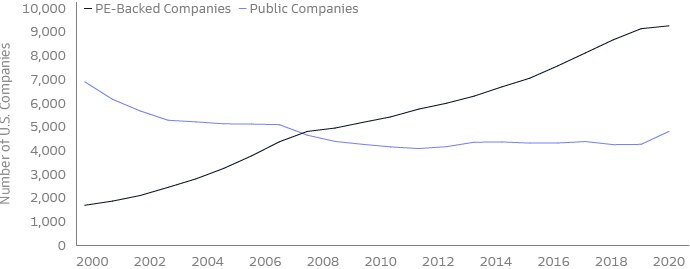
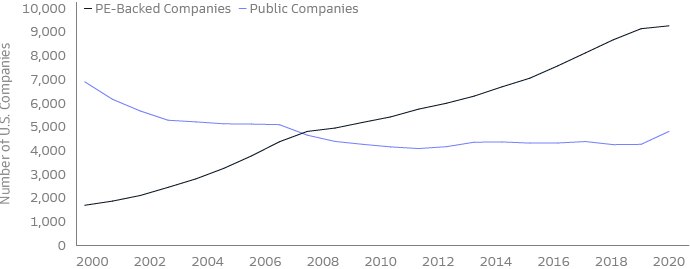
As an asset class, private equity has gained increasing attention among both companies looking to access capital and investors looking to diversify beyond traditional public markets. Over the last two decades, the number of companies backed with private capital has grown significantly, while the number of publicly listed firms has contracted (see below figure). This trend has been driven in part by increasing regulatory requirements of public companies and the accumulation of investor capital looking for alternative sources of return. Given the increased complexity and higher thresholds governing investor access to private equity (including potential illiquidity and higher investment minimums), it’s important to understand the nuances of investing in this growing asset class.


The Universe of PE-Backed Companies Has Grown While The Universe of Public Companies Has Shrunk
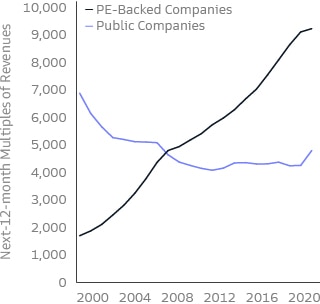
 

Source: PitchBook as of 6/30/2021. Public companies over time: World Bank, McKinsey.


What is Private Equity?

Private equity refers to investments in the equity of companies not listed on a public stock exchange. Most investors access these opportunities through private equity funds— pooled investment vehicles where a private equity manager, or General Partner (GP), identifies, evaluates, acquires, and manages investments on behalf of a group of investors, or Limited Partners (LPs).* The fund manager draws down the capital committed to the fund to invest in companies as opportunities arise, typically over multiple years.


The ultimate goal of a private equity fund is to increase the value of its stakes in companies and to realize a profit upon exiting each investment, through an initial public offering, sale, or other liquidity event. As exits occur, the realized proceeds are returned to investors until the final investment is sold and the fund is liquidated.


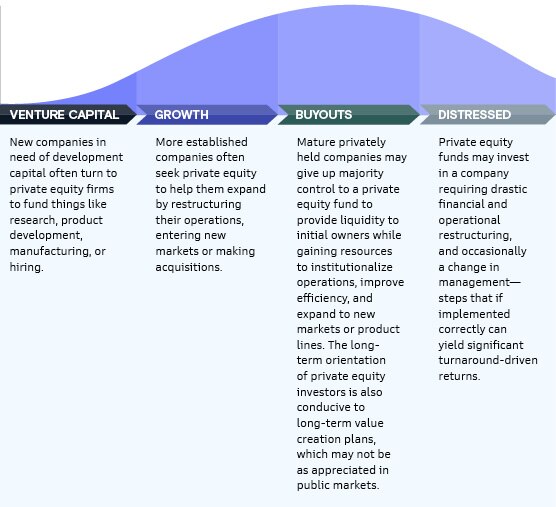
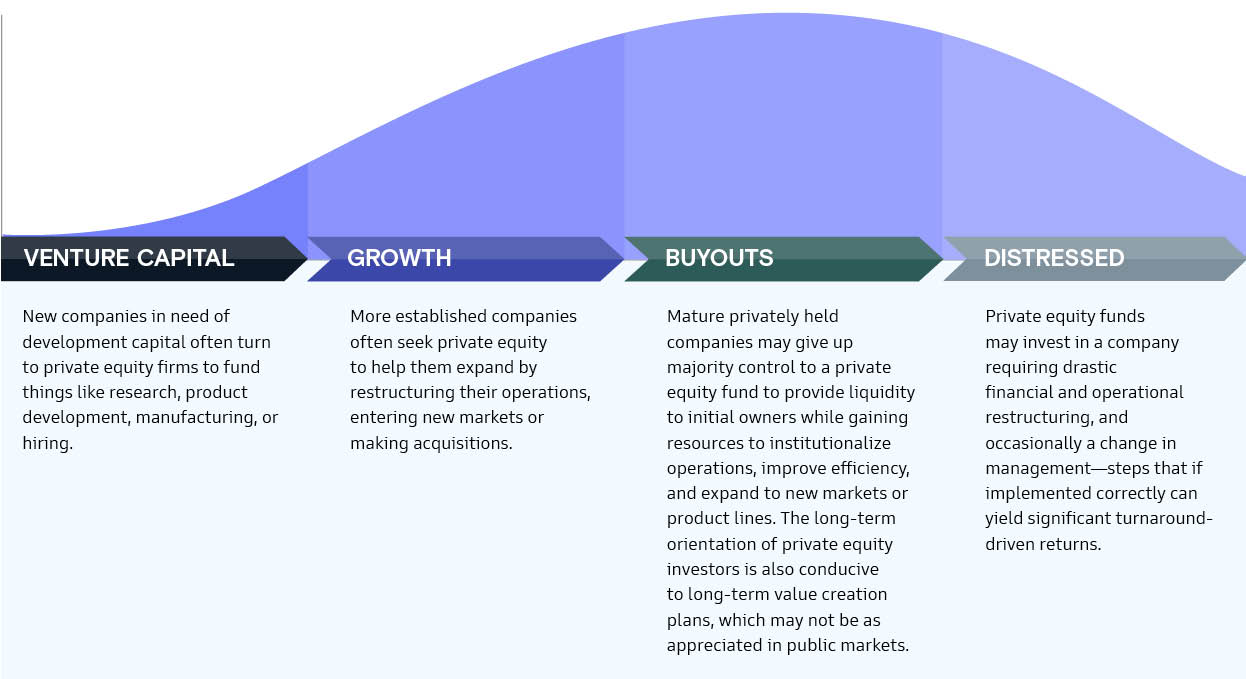
Private Equity Funds Tend to Focus on One of Four Main Investment Strategies That Span the Maturity Spectrum:


Why Invest in Private Equity?


Private equity can add value to investor’s portfolios in two main ways.

First, by giving access to investment opportunities that are simply not available in public markets. As companies stay private for longer, much of the value that was previously generated in public markets is now being built under private ownership.


Second, by private equity managers working hand-in-hand with their portfolio companies, boosting growth trajectories and operating efficiency. Since private fund managers have more concentrated ownership, it is easier for them to influence the companies they own. Experienced managers have extensive expertise in everything from growing and scaling businesses, to improving strategy and operations, to integrating technology for growth and efficiency. Such expertise is more important than ever in today’s environment of accelerated growth and emphasis on resiliency, agility and innovation.


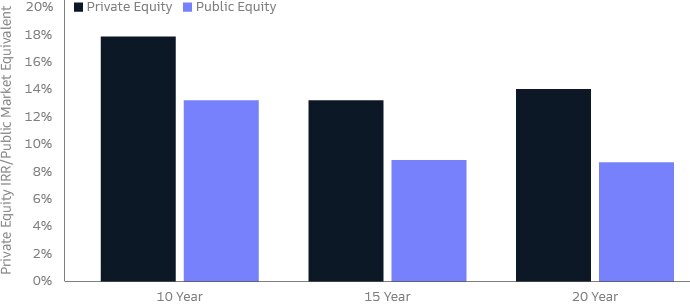
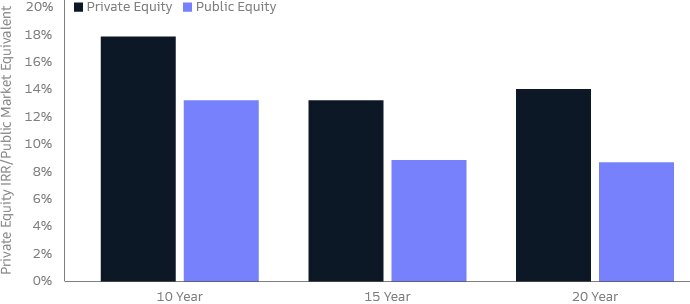
Aided by these sources of value creation, private equity can offer differentiated, attractive returns—complementing traditional investment portfolios. Historically, private equity has achieved returns that have significantly exceeded those of public equity markets, over various time horizons (below figure).


Private Equity Has Outperformed Over Various Time Horizons
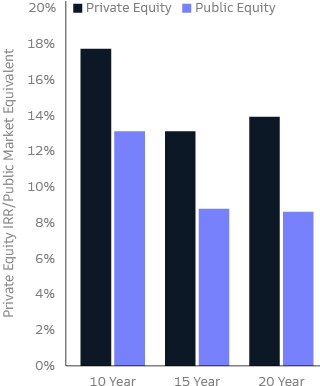
 

Source: Cambridge Associates, data as of December 2021. Private equity returns shown net of fees. Past performance does not guarantee future results, which may vary. Public equity data shown via a public market equivalent (PME) methodology, which reflect the performance of a public market index (MSCI World Index) expressed in terms of an internal rate of return and takes into account the timings of a private equity fund’s cash flows. PME returns do not represent the actual performance of the index. Indices are unmanaged and investors cannot invest in indices. The index returns used to calculate PME returns are gross total return, with dividends reinvested and do not reflect the deduction of any fees or expenses, which would reduce returns.


Evolution of the Asset Class

The first expression of private equity was in the form of venture capital firms formed in the 1940s as a way to finance innovative new ideas. Since then, private equity has played an important role in financing innovation and supporting the growth of the global economy.


Venture capital firms funded groundbreaking technologies that laid the foundation for the explosive growth of personal computing and the internet, continually evolving their strategy to meet the changing needs of startup companies. Today, venture capital strategies have proliferated to target specific sectors and stages of company development.


The buyout strategy has grown and evolved significantly since it first came to prominence in the 1980s. In its early stages, a meaningful component of its returns came from using a large amount of debt to finance the purchase of portfolio companies— an approach that amplified returns on the equity investment. As a result, buyout managers tended to seek companies with stable cash flows, typically in steadier but slower-growth sectors such as industrials and consumer staples. With much of the cash flow used for repaying the debt, less funding was available to reinvest in the company’s growth—which moderated portfolio companies’ growth prospects.


Today, buyout strategies take a different approach, focusing on growing and creating value within their portfolio companies. They have become active owners, working closely alongside their portfolio companies’ management teams. Some of the largest private equity managers have teams dedicated exclusively to value creation initiatives, with members specializing in discrete aspects of driving company value, such as customer acquisition, supply chain optimization, and talent management. A recent academic study has found that these activities have been the largest driver of value creation of private equity funds over the past 15 years.


With an increased focus on growth, resiliency, agility, and innovation, the mix of companies being acquired by buyout managers has shifted as well. Increasingly, focus has shifted towards companies powering the economy of the future, including companies developing software and other technologies. The typical buyout today features a lower portion of debt than three decades ago. However, buyout portfolio companies still have higher debt levels than their public counterparts, so cash flow generation continues to be important. As such, emphasis continues to be on companies with resilient business models and steady, predictable cash flows—and with the evolution of the technology industry towards such business models, buyout managers have been capitalizing on a growing opportunity set.


Finding the Right Partner

While aggregate performance is strong, dispersion of returns across individual investments, and, indeed, across different managers in private equity can be substantial. This makes finding the right partner critical. Manager skill is not evenly distributed, as evidenced by the high degree of performance dispersion among private equity funds, magnifying the importance of manager selection. Firms with deep experience through market cycles and extended global reach are better positioned to effectively deploy investor capital in value-creating investments. 


download

Save A Copy of this PDF

Introduction to Private Equity

Related Insights

×

Start the Conversation

Committed to providing you with the insights you need to build your practice.


Disclosures

Index Benchmarks

Indices are unmanaged. The figures for the index reflect the reinvestment of all income or dividends, as applicable, but do not reflect the deduction of any fees or expenses which would reduce returns. Investors cannot invest directly in indices.

The indices referenced herein have been selected because they are well known, easily recognized by investors, and reflect those indices that the Investment Manager believes, in part based on industry practice, provide a suitable benchmark against which to evaluate the investment or broader market described herein.

The MSCI World Index is a market cap weighted stock market index of 1,546 companies throughout the world. It is maintained by MSCI, formerly Morgan Stanley Capital International, and is used as a common benchmark for ‘world’ or ‘global’ stock funds intended to represent a broad cross-section of global markets.

This paper makes no implied or express recommendations concerning how a client’s account should be managed and is not intended to be used as a general guide to investing or as a source of any specific investment recommendations.

The opinions expressed in this paper are those of the authors, and not necessarily of Goldman Sachs. The investments discussed in this paper do not represent any Goldman Sachs product.

In connection with your consideration of an investment in any Alternative Investment, you should be aware of the following risks: Alternative Investments are subject to less regulation than other types of pooled investment vehicles such as mutual funds. Alternative Investments may impose significant fees, including incentive fees that are based upon a percentage of the realized and unrealized gains, and such fees may offset all or a significant portion of such Alternative Investment’s trading profits. An individual’s net returns may differ significantly from actual returns. Alternative Investments are not required to provide periodic pricing or valuation information. Investors may have limited rights with respect to their investments, including limited voting rights and participation in the management of the Alternative Investment.

Alternative Investments often engage in leverage and other investment practices that are extremely speculative and involve a high degree of risk. Such practices may increase the volatility of performance and the risk of investment loss, including the loss of the entire amount that is invested.

Alternative Investments may purchase instruments that are traded on exchanges located outside the United States that are “principal markets” and are subject to the risk that the counterparty will not perform with respect to contracts.

Alternative Investments are offered in reliance upon an exemption from registration under the Securities Act of 1933, as amended, for offers and sales of securities that do not involve a public offering. No public or other market is available or will develop. Similarly, interests in an Alternative Investment are highly illiquid and generally are not transferable without the consent of the sponsor, and applicable securities and tax laws will limit transfers.

Alternative Investments may themselves invest in instruments that may be highly illiquid and extremely difficult to value. This also may limit your ability to redeem or transfer your investment or delay receipt of redemption or transfer proceeds.

Alternative Investments are not required to provide their investors with periodic pricing or valuation information.

Alternative Investments may involve complex tax and legal structures and accordingly are only suitable for sophisticated investors. You are urged to consult with your own tax, accounting and legal advisers regarding any investment in any Alternative Investment.

Private equity investments are speculative, highly illiquid, involve a high degree of risk, have high fees and expenses that could reduce returns, and subject to the possibility of partial or total loss of capital. They are, therefore, intended for experienced and sophisticated long-term investors who can accept such risks.

Equity securities are more volatile than bonds and subject to greater risks. Small and mid-sized company stocks involve greater risks than those customarily associated with larger companies.

Bonds are subject to interest rate, price and credit risks. Prices tend to be inversely affected by changes in interest rates.

High yield fixed income securities are considered speculative, involve greater risk of default, and tend to be more volatile than investment grade fixed income securities.

Alternative Investments such as hedge funds are subject to less regulation than other types of pooled investment vehicles such as mutual funds, may make speculative investments, may be illiquid and can involve a significant use of leverage, making them substantially riskier than the other investments. An Alternative Investment Fund may incur high fees and expenses which would offset trading profits. Alternative Investment Funds are not required to provide periodic pricing or valuation information to investors. The Manager of an Alternative Investment Fund has total investment discretion over the investments of the Fund and the use of a single advisor applying generally similar trading programs could mean a lack of diversification, and consequentially, higher risk. Investors may have limited rights with respect to their investments, including limited voting rights and participation in the management of the Fund.

Alternative Investments by their nature, involve a substantial degree of risk, including the risk of total loss of an investor’s capital. Fund performance can be volatile. There may be conflicts of interest between the Alternative Investment Fund and other service providers, including the investment manager and sponsor of the Alternative Investment. Similarly, interests in an Alternative Investment are highly illiquid and generally are not transferable without the consent of the sponsor, and applicable securities and tax laws will limit transfers.

Investments in fixed-income securities are subject to credit and interest rate risks. Bond prices fluctuate inversely to changes in interest rates. Therefore, a general rise in interest rates can result in the decline in the bond’s price. Credit risk is the risk that an issuer will default on payments of interest and principal. This risk is higher when investing in high yield bonds, also known as junk bonds, which have lower ratings and are subject to greater volatility. All fixed income investments may be worth less than their original cost upon redemption or maturity.

There may be additional risks that are not currently foreseen or considered.

FOR PROFESSIONAL USE ONLY (WITHIN THE MEANING OF THE MIFID DIRECTIVE, NOT FOR PUBLIC DISTRIBUTION. THIS DOCUMENT IS PROVIDED FOR SPECIFIC INFORMATION PURPOSES ONLY IN ORDER TO ENABLE THE RECIPIENT TO ASSESS THE FINANCIAL CHARACTERISTICS OF THE CONCERNED FINANCIAL INSTRUMENT(S) AS PROVIDED FOR IN ARTICLE L. 533-13-1, I, 2° OF THE FRENCH MONETARY AND FINANCIAL CODE AND DOES NOT CONSTITUTE AND MAY NOT BE USED AS MARKETING MATERIAL FOR INVESTORS OR POTENTIAL INVESTORS IN FRANCE.

Asia Pacific: Please note that neither Goldman Sachs Asset Management International nor any other entities involved in the Goldman Sachs Asset Management (GSAM) business maintain any licenses, authorizations or registrations in Asia (other than Japan), except that it conducts businesses (subject to applicable local regulations) in and from the following jurisdictions: Hong Kong, Singapore and Malaysia. This material has been issued for use in or from Hong Kong by Goldman Sachs Asset Management (Hong Kong) Limited, in or from Singapore by Goldman Sachs Asset Management (Singapore) Pte. Ltd. (Company Number: 201329851H) and in or from Malaysia by Goldman Sachs (Malaysia) Sdn Berhad (880767W).

To the extent that this document contains any statement which may be considered to be financial product advice in Australia under the Corporations Act 2001 (Cth), that advice is intended to be given to the intended recipient of this document only, being a wholesale client for the purposes of the Corporations Act 2001 (Cth). Any advice provided in this document is provided by either Goldman Sachs Asset Management International (GSAMI), Goldman Sachs International (GSI), Goldman Sachs Asset Management, LP (GSAMLP) or Goldman Sachs & Co. LLC (GSCo). Both GSCo and GSAMLP are regulated by the US Securities and Exchange Commission under US laws, which differ from Australian laws. Both GSI and GSAMI are regulated by the Financial Conduct Authority and GSI is authorized by the Prudential Regulation Authority under UK laws, which differ from Australian laws. GSI, GSAMI, GSCo, and GSAMLP are all exempt from the requirement to hold an Australian financial services licence under the Corporations Act of Australia and therefore do not hold any Australian Financial Services Licences. Any financial services given to any person by GSI, GSAMI, GSCo or GSAMLP by distributing this document in Australia are provided to such persons pursuant to ASIC Class Orders 03/1099 and 03/1100.

Australia: This material is distributed by Goldman Sachs Asset Management Australia Pty Ltd ABN 41 006 099 681, AFSL 228948 (‘GSAMA’) and is intended for viewing only by wholesale clients for the purposes of section 761G of the Corporations Act 2001 (Cth). This document may not be distributed to retail clients in Australia (as that term is defined in the Corporations Act 2001 (Cth)) or to the general public. This document may not be reproduced or distributed to any person without the prior consent of GSAMA. To the extent that this document contains any statement which may be considered to be financial product advice in Australia under the Corporations Act 2001 (Cth), that advice is intended to be given to the intended recipient of this document only, being a wholesale client for the purposes of the Corporations Act 2001 (Cth). Any advice provided in this document is provided by either GoldmanSachs Asset Management International (GSAMI), Goldman Sachs International (GSI), Goldman Sachs Asset Management, LP (GSAMLP) or Goldman Sachs & Co. LLC (GSCo). Both GSCo and GSAMLP are regulated by the US Securities and Exchange Commission under US laws, which differ from Australian laws. Both GSI and GSAMI are regulated by the Financial Conduct Authority and GSI is authorized by the Prudential Regulation Authority under UK laws, which differ from Australian laws. GSI, GSAMI, GSCo, and GSAMLP are all exempt from the requirement to hold an Australian financial services licence under the Corporations Act of Australia and therefore do not hold any Australian Financial Services Licences. Any financial services given to any person by GSI, GSAMI, GSCo or GSAMLP by distributing this document in Australia are provided to such persons pursuant to ASIC Class Orders 03/1099 and 03/1100. No offer to acquire any interest in a fund or a financial product is being made to you in this document. If the interests or financial products do become available in the future, the offer may be arranged by GSAMA in accordance with section 911A(2)(b) of the Corporations Act. GSAMA holds Australian Financial Services Licence No. 228948. Any offer will only be made in circumstances where disclosure is not required under Part 6D.2 of the Corporations Act or a product disclosure statement is not required to be given under Part 7.9 of the Corporations Act (as relevant).

The opinions expressed in this paper are those of the authors, and not necessarily of Goldman Sachs Asset Management. The investments and returns discussed in this paper do not represent any Goldman Sachs product.

Although certain information has been obtained from sources believed to be reliable, we do not guarantee its accuracy, completeness or fairness. We have relied upon and assumed without independent verification, the accuracy and completeness of all information available from public sources.

The views expressed herein are as of November 30, 2020 and subject to change in the future. Individual portfolio management teams for Goldman Sachs Asset Management may have views and opinions and/or make investment decisions that, in certain instances, may not always be consistent with the views and opinions expressed herein.

Views and opinions expressed are for informational purposes only and do not constitute a recommendation by Goldman Sachs Asset Management to buy, sell, or hold any security. Views and opinions are current as of the date of this document and may be subject to change, they should not be construed as investment advice.

Confidentiality

No part of this material may, without Goldman Sachs Asset Management ‘s prior written consent, be (i) copied, photocopied or duplicated in any form, by any means, or (ii) distributed to any person that is not an employee, officer, director, or authorized agent of the recipient.

Date of first use: July 10, 2022.

281258-OTU-1620340

Please enter your email address to continue reading.

Confirm Your Access


An email has been sent to you to verify ownership of your email address.

Please verify the link in the email by clicking the confirmation button. Once completed, you will gain instant access to our insights.

If you did not receive the email from us please check your spam folder or try again.