








October 31, 2023 |
GSAM Perspectives


In The Spotlight
In The Spotlight
In The Spotlight
Stay on top of the latest market developments, key themes, and investment ideas affecting your portfolio and practices.
Explore how we can help you
Contact Us

Jonathan BussEconomist and Fixed Income Portfolio Manager Jonathan Buss |

Stephanie HuiHead of Private Equity in Asia and Global Co-Head of Growth Equity Stephanie Hui |

Ichiro KosugeHead of Japan Fundamental Equity Ichiro Kosuge |
For three decades, Japan's economy stayed stagnant, plagued by a combination of low growth, low inflation, and low interest rates. The term “Japanification” became shorthand for the country’s prolonged economic plight and a warning to other advanced economies hoping to avoid the same fate. However, Japan’s economy is experiencing a revival in 2023, spurred by domestic macroeconomic strength, a departure from deflation, and corporate governance reform. This long-awaited resurgence and the possibility of a once-in-a-generation re-rating for Japanese assets has led to a meaningful shift in investor sentiment. The Tokyo Stock Price Index (TOPIX) hit its highest point since 1990 in mid-September and foreign investments into Japan continue to rise. The outlook for the world's third-largest economy looks more favorable than it has in many years. We believe long-term investment success in Japan requires a strategic approach; one that looks beyond near-term dynamics and considers a range of macroeconomic scenarios, domestic tailwinds, and secular trends. Active investing across public and private markets may prove rewarding if it’s combined with on-the-ground expertise and an understanding of Japanese business practices.
Japan finds itself in a domestic demand recovery characterized by an unfamiliar yet desirable cycle of rising prices and wage growth. Inflation is hitting levels that have not been seen since the early 1980s and has even exceeded the Bank of Japan’s (BoJ) 2% target; welcome news for an economy which has remained stagnant and faced deflation for a long time. Higher food and energy costs fueled the initial inflation ascent—consistent with global trends—but price increases have broadened out as 2023 has progressed. Services prices, for instance, have accelerated sharply, reflecting the strong increase in hotel demand amid recent re-opening momentum and the recovery in travel-related consumption. Rail fares, delivery fees and restaurant prices have all climbed higher. Simultaneously, Japan's “Shunto” negotiations between labor unions and companies have resulted in negotiated wage hikes well above usual levels. Data suggest the base pay rise (+2.12%) agreed in spring is the largest since 1992 and headline wage growth (+3.58%) is the highest since 1993.1 The extent to which this wage growth will lift inflation is a key factor for monetary policy going forward.
Source: Goldman Sachs Global Investment Research. As of June 2023.
The BoJ has long viewed a virtuous cycle between wage growth and rising prices as essential for achieving its inflation target in a sustainable manner. It remains too early to tell whether the BoJ’s desired virtuous cycle has been achieved. There has yet to be a fundamental reversal in the direction of monetary policy, which remains ultra-easy. However, we believe strength in underlying inflation—as confirmed by July and August Tokyo core CPI inflation data—supports the case for a gradual normalization of policy over the coming year, including an exit from negative interest rates. That said, we think the risk of large upward or downward swings in inflation still warrant attention. The biggest upside risk is an uncontrolled wage-price spiral, a positive feedback loop between rising wages and prices. On the other hand, extensions of government energy subsidies represent a downside risk to inflation. In August, Prime Minister Kishida announced plans to expand gasoline subsidies and extend them until the end of 2023.2 Longer term, Japan’s shrinking and aging population may have the potential to cause either inflation or deflation in the years ahead. Until now, Japan has partially offset deteriorating demographics by raising labor force participation (higher female participation and higher elderly worker participation). But in the coming decade, the impact of a shrinking workforce may exert upward pressure on wages if the labor supply doesn’t grow through immigration. Eventual outcomes may depend on Japan’s ability to enact structural reforms to improve labor force participation, as well as the interaction of demographics with other structural forces like deglobalization, decarbonization and digitization.
Yield curve control (YCC) measures continue to remain in place in Japan, having been introduced in 2016 to head off deflationary risks and to achieve an inflation target of 2%. This summer the BoJ—now under the leadership of Governor Kazuo Ueda—effectively relaxed its YCC policy by raising the rate for fixed-rate purchase operations from 0.5% to 1.0%. The rationale for the July adjustment was framed around ensuring bond market functioning, but also reflected an acknowledgement of firm inflation and rising inflation expectations. As expected, Japanese government bond (JGB) yields trended higher following the July meeting. Investors should keep potential implications for global fixed income markets in mind. Higher local bond yields may lead Japanese institutional investors to repatriate capital invested overseas back to Japan. JGB yields remain lower than fixed income assets outside of Japan. But after taking into consideration currency hedging costs—as many Japanese institutional investors do—JGB yields appear attractive in a global context. This points to a shift in asset allocation ahead and we are mindful of the impact on US agency mortgage-backed securities, US Treasuries and Australian sovereign bonds, given the large footprint of Japanese investors in these markets. That said, the speed of repatriation of capital away from global fixed income back to JGBs remains uncertain.
Investors must weigh other potential currency implications of Japan’s rising prices and wage growth, particularly in a market which has seen so little of either in the past 30 years. At present, Japanese companies with a high foreign exposure look to be in the most competitive position in decades with the yen trading at levels that have not been seen since the early 2000s. Domestic focused firms, such as consumer goods companies, retailers, and hotels, are also enjoying a long-awaited boost from increased tourism. The weaker yen makes Japan a more affordable travel destination for foreigners, notably Asian tourists. Now that yen movements have become more dramatic than in the past, foreign exchange (FX) sensitivity is an important parameter impacting corporate profitability and investment portfolios. In addition to FX hedging strategies, the key for investors may lie in finding companies with better cost structures, offshore manufacturing and market leading positions as these types of businesses tend to be resilient to exchange rate movements. Active investment managers can position themselves appropriately to ensure minimum impact from FX movements.
Source: Japan National Tourism Organization. As of July 31, 2023.
Arguably the most powerful game-changer for Japanese equities in recent years has been increased momentum of corporate governance reform. This is a key part of the “third arrow” of structural reforms first introduced when former Prime Minister Abe came into power for a second time in 2012. The Tokyo Stock Exchange (TSE) continues to focus on boosting corporate value to make Japanese stocks more compelling for investors who have long regarded Japan as a "value trap"—a market that appears attractively underpriced but fails to move toward value. One of the TSE's motivations for reform appears to be the key structural differences between the TSE Prime market and other developed stock market indices in terms of price-to-book value ratios and return on equity distributions. Japanese companies are becoming better stewards of capital and are committing excess cash to record levels of buybacks and dividends. This is attracting foreign investors back to Japan’s public equity market. The TSE is also encouraging more retail investor participation. Only 11% of Japanese household assets are invested in equities versus 20% in Europe, and almost 40% in the US.3 Going forward, further efforts to boost corporate valuations, combined with rising retail and foreign investor demand, could reinforce any upward trajectory of stock prices.
Pressure on companies that do not comply with TSE guidelines has been steadily increasing. Insufficient disclosures and explanations about areas of non-compliance, or a lack of urgency about meeting listing requirements, are now being actively highlighted as areas of concern. Companies are seeing not only pressure from the TSE, but also from investors, given increasing activist activity and investor engagement to improve management through stewardship. There is also a growing consensus about the negative implications inherent in cross-shareholdings ownership, or inter-corporate shareholding, which has been a common practice in Japan. From a capital efficiency and corporate governance standpoint, foreign investors have often emphasized that this is a key area where capital management should be improved. Taking action to avoid negative consequences can be a powerful motivator in any corporate culture, but this appears to be particularly true in the case of Japan. Data suggests more listed companies are following TSE guidelines by presenting cost of capital calculations and outlining initiatives to boost corporate value; those that did fared particularly well during 1Q 2023 earnings season.4 Looking further ahead, corporate transformation in Japan will create winners and losers, with some management teams proactively seeking to use governance reforms as a channel to achieve sustainable growth, while others fail to keep up. As active, long-term investors in Japan’s public equity market, we see the next few years as an interesting time to potentially benefit from this meaningful differentiation and continue to focus on identifying strong management teams with shareholder friendly track records.
Corporate governance reform momentum is also fueling activity in Japan’s private equity (PE) market, which has grown significantly in recent years with approximately $20 billion in deal value annually, driven by larger transactions. Dealmaking by private equity funds in Japan roughly doubled in the first six months of 2023 compared with a decline of roughly 40% in the Americas and 65% in Europe, albeit from a smaller base. Approximately half of Japan’s public equity market continues to trade at book value despite the TOPIX’s surge. As a result, take-privates and carveouts are being circled by general partners (GPs); the $14-billion take-private deal for Toshiba early this year could prove to be a harbinger.5 Japanese corporations often have a less-focused portfolio than their global counterparts, suggesting certain businesses have the potential to thrive more under independent management. The momentum behind divestitures may continue given the ongoing improvements in corporate governance and transparency.6
Japan is not home to an abundance of high-growth innovators and disruptors. But it has several unique technology companies with vital roles in automation, digitization, semiconductors, electronics supply chains and advanced healthcare. Many are not well-represented by Japanese indices which continue to have significant aggregate exposure to cyclical and low growth areas such as auto manufacturers, banks, commodities, transportation, and telecom companies. These top industries make up more than 70% of the TOPIX by weight.7 Some of these sectors were prominent a few decades ago, but these are no longer the areas with the highest future growth potential. Just below this top tier in terms of size, we see many high-quality, long-term growth opportunities. This contrasts with other developed markets like the US, where the indices and markets tend to be led by the faster growing areas of the market. Japanese equities have shown one of the lowest degrees of long-term correlations with both developed and emerging market indices, driven by the uniqueness of domestic economy and corporate landscape. In our view, the key to investing in Japan will lie in identifying companies that are underrepresented within indices but that are aligned to structural growth trends, and capable of outperforming over the long-term. We believe that active managers in Japan can provide a better forward-looking exposure while limiting allocation to legacy low-growth sectors.
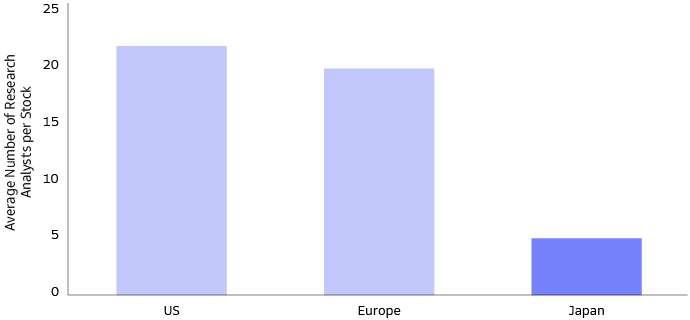
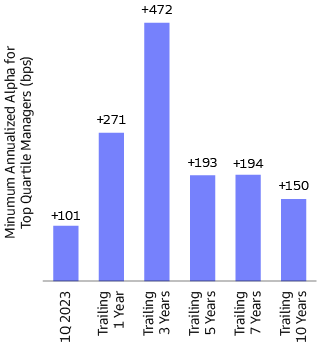
Source: Bloomberg. As of June 2023. eVestment. As of March 2023. Bars represent the range of returns from managers in the Japan Large Cap eVestment universe. Trailing periods as of March 2023 end. Past performance does not guarantee future results, which may vary.
Despite being home to one of the largest stock exchanges in the world, Japanese equities have largely been out of favor for many investors and under-researched, with no analysts covering 45% of the TOPIX. By comparison, only 3% of the Russell 3000 Index (a proxy for the US equity market) lacks analyst coverage. For investors with strong research capabilities, a local presence and deep understanding of accounting standards and cultural factors—including cultural conservatism, deeper and longer-term corporate business relationships—we see Japan as fertile ground for alpha generation through active management. In contrast to many other markets, the investment landscape in Japan has historically boded well for active equity managers over time with the minimum annualized alpha for top-quartile players amounting to +472 bps and +193 bps over trailing 3- and trailing 5-year periods.8 In today’s highly uncertain world, the impact of strong, consistent alpha generation is likely to be more pronounced than ever before.
Delivering strong and consistent returns also requires investors to identify regional and global geopolitical risks and embrace potential opportunities where they can be found. With conflicts between countries and competition for national interests becoming more pronounced, Prime Minister Kishida has committed to reinforce Japan's defense capabilities, noting cybersecurity and digitalization as increasingly important areas for national security.9 Many Japanese businesses already hold leading positions in materials and precision manufacturing, robotics, and factory automation—sectors that are likely to see strong demand as global supply chains realign and companies seek efficiency gains. The backdrop for Japan’s semiconductor industry also looks favorable with US trade restrictions on China and global semiconductor supply chains being rebuilt. Some of world’s largest semiconductor makers have announced plans to deepen tech partnerships in Japan following moves by the government to provide subsidies for domestic chipmaking. This may complement the country’s already advanced standing semiconductor packaging and substrate technologies—increasingly important areas given future technological trends like artificial intelligence (AI) rely on improved semiconductor performance. In some areas, private capital may be advantaged by its ability to provide a long-term, patient investment that reacts less to near-term geopolitical gyrations. On the other hand, public market investors with the ability to draw on both global intellectual capital and on-the-ground expertise in Japan may also be able to navigate uncertainty and generate long-term outperformance.
Japan’s economic revival and intense focus on improving governance standards have captured investors’ attention and may provide a powerful tailwind for corporate earnings in the years to come. In the near term, we expect earnings to remain resilient driven by a weaker currency, rising inbound tourism, strong corporate capex and other positive long-term structural changes that are underway. However, we expect the upcoming quarters to be key in determining whether the recent macroeconomic and market resurgence can turn into a more permanent positive reality for Japan. If both consumer and corporate activity changes in line with a shift from a deflationary to an inflationary mindset, this would likely have positive long-term implications for business, investment, and growth. Over the long-term, investment success in Japan may require an active investment approach across public and private markets. Japan seems on the cusp of a new dawn. Investors that focus on companies that are both secular growth winners and committed to corporate reforms may end up on the right side of change.


Committed to providing you with the insights you need to build your practice.
1 Goldman Sachs Global Investment Research (GIR). As of July 5, 2023.
2 The Japan Times. As of August 30, 2023.
3 Goldman Sachs Global Investment Research (GIR). As of May 29, 2023.
4 Goldman Sachs Global Investment Research (GIR). As of August 13, 2023.
5 Private Equity International. As of April 3, 2023.
6 Japan Private Equity Association. As of August 22, 2023.
7 Goldman Sachs Asset Management. Factset. As of July 31, 2023.
8 S&P Indices Versus Active (SPIVA) SPIVA Report – Japan Scorecard 2022. Past performance does not guarantee future results, which may vary.
9 Prime Minister’s Office of Japan. Policy speech at Johns Hopkins University School of Advanced International Studies. As of January 12, 2023.
Risk Considerations
All investing involves risk, including loss of principal.
Equity investments are subject to market risk, which means that the value of the securities in which it invests may go up or down in response to the prospects of individual companies, particular sectors and/or general economic conditions. Different investment styles (e.g., “growth” and “value”) tend to shift in and out of favor, and, at times, the strategy may underperform other strategies that invest in similar asset classes. The market capitalization of a company may also involve greater risks (e.g. "small" or "mid" cap companies) than those associated with larger, more established companies and may be subject to more abrupt or erratic price movements, in addition to lower liquidity.
Investments in fixed income securities are subject to the risks associated with debt securities generally, including credit, liquidity, interest rate, prepayment and extension risk. Bond prices fluctuate inversely to changes in interest rates. Therefore, a general rise in interest rates can result in the decline in the bond’s price. The value of securities with variable and floating interest rates are generally less sensitive to interest rate changes than securities with fixed interest rates. Variable and floating rate securities may decline in value if interest rates do not move as expected. Conversely, variable and floating rate securities will not generally rise in value if market interest rates decline. Credit risk is the risk that an issuer will default on payments of interest and principal. Credit risk is higher when investing in high yield bonds, also known as junk bonds. Prepayment risk is the risk that the issuer of a security may pay off principal more quickly than originally anticipated. Extension risk is the risk that the issuer of a security may pay off principal more slowly than originally anticipated. All fixed income investments may be worth less than their original cost upon redemption or maturity. High-yield, lower-rated securities involve greater price volatility and present greater credit risks than higher-rated fixed income securities
International securities may be more volatile and less liquid and are subject to the risks of adverse economic or political developments. International securities are subject to greater risk of loss as a result of, but not limited to, the following: inadequate regulations, volatile securities markets, adverse exchange rates, and social, political, military, regulatory, economic or environmental developments, or natural disasters.
The portfolio risk management process includes an effort to monitor and manage risk, but does not imply low risk.
The above are not an exhaustive list of potential risks. There may be additional risks that are not currently foreseen or considered.
General Disclosures
The website links provided are for your convenience only and are not an endorsement or recommendation by Goldman Sachs Asset Management of any of these websites or the products or services offered. Goldman Sachs Asset Management is not responsible for the accuracy and validity of the content of these websites.
This material is provided for educational purposes only and should not be construed as investment advice or an offer or solicitation to buy or sell securities.
THIS MATERIAL DOES NOT CONSTITUTE AN OFFER OR SOLICITATION IN ANY JURISDICTION WHERE OR TO ANY PERSON TO WHOM IT WOULD BE UNAUTHORIZED OR UNLAWFUL TO DO SO.
Prospective investors should inform themselves as to any applicable legal requirements and taxation and exchange control regulations in the countries of their citizenship, residence or domicile which might be relevant.
Economic and market forecasts presented herein reflect a series of assumptions and judgments as of the date of this material and are subject to change without notice. These forecasts do not take into account the specific investment objectives, restrictions, tax and financial situation or other needs of any specific client. Actual data will vary and may not be reflected here. These forecasts are subject to high levels of uncertainty that may affect actual performance. Accordingly, these forecasts should be viewed as merely representative of a broad range of possible outcomes. These forecasts are estimated, based on assumptions, and are subject to significant revision and may change materially as economic and market conditions change. Goldman Sachs has no obligation to provide updates or changes to these forecasts. Case studies and examples are for illustrative purposes only.
This information discusses general market activity, industry or sector trends, or other broad-based economic, market or political conditions and should not be construed as research or investment advice. This material has been prepared by Goldman Sachs Asset Management and is not financial research nor a product of Goldman Sachs Global Investment Research (GIR). It was not prepared in compliance with applicable provisions of law designed to promote the independence of financial analysis and is not subject to a prohibition on trading following the distribution of financial research. The views and opinions expressed may differ from those of Goldman Sachs Global Investment Research or other departments or divisions of Goldman Sachs and its affiliates. Investors are urged to consult with their financial advisors before buying or selling any securities. This information may not be current and Goldman Sachs Asset Management has no obligation to provide any updates or changes.
The views expressed herein are as of the date of the publication and subject to change in the future. Individual portfolio management teams for Goldman Sachs Asset Management may have views and opinions and/or make investment decisions that, in certain instances, may not always be consistent with the views and opinions expressed herein.
Views and opinions expressed are for informational purposes only and do not constitute a recommendation by Goldman Sachs Asset Management to buy, sell, or hold any security. Views and opinions are current as of the date of this material and may be subject to change, they should not be construed as investment advice.
This material is provided for informational purposes only and should not be construed as investment advice or an offer or solicitation to buy or sell securities. This material is not intended to be used as a general guide to investing, or as a source of any specific investment recommendations, and makes no implied or express recommendations concerning the manner in which any client’s account should or would be handled, as appropriate investment strategies depend upon the client’s investment objectives.
Index Benchmarks
Indices are unmanaged. The figures for the index reflect the reinvestment of all income or dividends, as applicable, but do not reflect the deduction of any fees or expenses which would reduce returns. Investors cannot invest directly in indices.
The indices referenced herein have been selected because they are well known, easily recognized by investors, and reflect those indices that the Investment Manager believes, in part based on industry practice, provide a suitable benchmark against which to evaluate the investment or broader market described herein.
Although certain information has been obtained from sources believed to be reliable, we do not guarantee its accuracy, completeness or fairness. We have relied upon and assumed without independent verification, the accuracy and completeness of all information available from public sources.
Past performance does not guarantee future results, which may vary. The value of investments and the income derived from investments will fluctuate and can go down as well as up. A loss of principal may occur.
United Kingdom: In the United Kingdom, this material is a financial promotion and has been approved by Goldman Sachs Asset Management International, which is authorized and regulated in the United Kingdom by the Financial Conduct Authority.
European Economic Area (EEA): This material is a financial promotion disseminated by Goldman Sachs Bank Europe SE, including through its authorised branches ("GSBE"). GSBE is a credit institution incorporated in Germany and, within the Single Supervisory Mechanism established between those Member States of the European Union whose official currency is the Euro, subject to direct prudential supervision by the European Central Bank and in other respects supervised by German Federal Financial Supervisory Authority (Bundesanstalt für Finanzdienstleistungsaufischt, BaFin) and Deutsche Bundesbank.
Switzerland: For Qualified Investor use only – Not for distribution to general public. This is marketing material. This document is provided to you by Goldman Sachs Bank AG, Zürich. Any future contractual relationships will be entered into with affiliates of Goldman Sachs Bank AG, which are domiciled outside of Switzerland. We would like to remind you that foreign (Non-Swiss) legal and regulatory systems may not provide the same level of protection in relation to client confidentiality and data protection as offered to you by Swiss law.
Asia excluding Japan: Please note that neither Goldman Sachs Asset Management (Hong Kong) Limited (“GSAMHK”) or Goldman Sachs Asset Management (Singapore) Pte. Ltd. (Company Number: 201329851H ) (“GSAMS”) nor any other entities involved in the Goldman Sachs Asset Management business that provide this material and information maintain any licenses, authorizations or registrations in Asia (other than Japan), except that it conducts businesses (subject to applicable local regulations) in and from the following jurisdictions: Hong Kong, Singapore, India and China. This material has been issued for use in or from Hong Kong by Goldman Sachs Asset Management (Hong Kong) Limited, in or from Singapore by Goldman Sachs Asset Management (Singapore) Pte. Ltd. (Company Number: 201329851H).
Hong Kong: This material has been issued or approved for use in or from Hong Kong by Goldman Sachs Asset Management (Hong Kong) Limited, a licensed entity regulated by the Securities and Futures Commission of Hong Kong (SFC). This material has not been reviewed by the SFC. © 2023 Goldman Sachs. All rights reserved.
Singapore: Investment involves risk. Prospective investors should seek independent advice. This advertisement or publication material has not been reviewed by the Monetary Authority of Singapore. This material has been issued or approved for use in or from Singapore by Goldman Sachs Asset Management (Singapore) Pte. Ltd. (Company Number: 201329851H).
Australia: This material is distributed by Goldman Sachs Asset Management Australia Pty Ltd ABN 41 006 099 681, AFSL 228948 (‘GSAMA’) and is intended for viewing only by wholesale clients for the purposes of section 761G of the Corporations Act 2001 (Cth). This document may not be distributed to retail clients in Australia (as that term is defined in the Corporations Act 2001 (Cth)) or to the general public. This document may not be reproduced or distributed to any person without the prior consent of GSAMA. To the extent that this document contains any statement which may be considered to be financial product advice in Australia under the Corporations Act 2001 (Cth), that advice is intended to be given to the intended recipient of this document only, being a wholesale client for the purposes of the Corporations Act 2001 (Cth). Any advice provided in this document is provided by either of the following entities. They are exempt from the requirement to hold an Australian financial services licence under the Corporations Act of Australia and therefore do not hold any Australian Financial Services Licences, and are regulated under their respective laws applicable to their jurisdictions, which differ from Australian laws. Any financial services given to any person by these entities by distributing this document in Australia are provided to such persons pursuant to the respective ASIC Class Orders and ASIC Instrument mentioned below.
· Goldman Sachs Asset Management, LP (GSAMLP), Goldman Sachs & Co. LLC (GSCo), pursuant ASIC Class Order 03/1100; regulated by the US Securities and Exchange Commission under US laws.
· Goldman Sachs Asset Management International (GSAMI), Goldman Sachs International (GSI), pursuant to ASIC Class Order 03/1099; regulated by the Financial Conduct Authority; GSI is also authorized by the Prudential Regulation Authority, and both entities are under UK laws.
· Goldman Sachs Asset Management (Singapore) Pte. Ltd. (GSAMS), pursuant to ASIC Class Order 03/1102; regulated by the Monetary Authority of Singapore under Singaporean laws
· Goldman Sachs Asset Management (Hong Kong) Limited (GSAMHK), pursuant to ASIC Class Order 03/1103 and Goldman Sachs (Asia) LLC (GSALLC), pursuant to ASIC Instrument 04/0250; regulated by the Securities and Futures Commission of Hong Kong under Hong Kong laws.
No offer to acquire any interest in a fund or a financial product is being made to you in this document. If the interests or financial products do become available in the future, the offer may be arranged by GSAMA in accordance with section 911A(2)(b) of the Corporations Act. GSAMA holds Australian Financial Services Licence No. 228948. Any offer will only be made in circumstances where disclosure is not required under Part 6D.2 of the Corporations Act or a product disclosure statement is not required to be given under Part 7.9 of the Corporations Act (as relevant).
New Zealand: This material is distributed in New Zealand by Goldman Sachs Asset Management Australia Pty Ltd ABN 41 006 099 681, AFSL 228948 (’GSAMA’) and is intended for viewing only by wholesale clients in Australia for the purposes of section 761G of the Corporations Act 2001 (Cth) and to clients who either fall within any or all of the categories of investors set out in section 3(2) or sub-section 5(2CC) of the Securities Act 1978, fall within the definition of a wholesale client for the purposes of the Financial Service Providers (Registration and Dispute Resolution) Act 2008 (FSPA) and the Financial Advisers Act 2008 (FAA),and fall within the definition of a wholesale investor under one of clause 37, clause 38, clause 39 or clause 40 of Schedule 1 of the Financial Markets Conduct Act 2013 (FMCA) of New Zealand (collectively, a “NZ Wholesale Investor”). GSAMA is not a registered financial service provider under the FSPA. GSAMA does not have a place of business in New Zealand. In New Zealand, this document, and any access to it, is intended only for a person who has first satisfied GSAMA that the person is a NZ Wholesale Investor. This document is intended for viewing only by the intended recipient. This document may not be reproduced or distributed to any person in whole or in part without the prior written consent of GSAMA.
Canada: This presentation has been communicated in Canada by GSAM LP, which is registered as a portfolio manager under securities legislation in all provinces of Canada and as a commodity trading manager under the commodity futures legislation of Ontario and as a derivatives adviser under the derivatives legislation of Quebec. GSAM LP is not registered to provide investment advisory or portfolio management services in respect of exchange-traded futures or options contracts in Manitoba and is not offering to provide such investment advisory or portfolio management services in Manitoba by delivery of this material.
Japan: This material has been issued or approved in Japan for the use of professional investors defined in Article 2 paragraph (31) of the Financial Instruments and Exchange Law by Goldman Sachs Asset Management Co., Ltd.
South Africa: Goldman Sachs Asset Management International is authorised by the Financial Services Board of South Africa as a financial services provider.
Colombia: Esta presentación no tiene el propósito o el efecto de iniciar, directa o indirectamente, la adquisición de un producto a prestación de un servicio por parte de Goldman Sachs Asset Management a residentes colombianos. Los productos y/o servicios de Goldman Sachs Asset Management no podrán ser ofrecidos ni promocionados en Colombia o a residentes Colombianos a menos que dicha oferta y promoción se lleve a cabo en cumplimiento del Decreto 2555 de 2010 y las otras reglas y regulaciones aplicables en materia de promoción de productos y/o servicios financieros y /o del mercado de valores en Colombia o a residentes colombianos. Al recibir esta presentación, y en caso que se decida contactar a Goldman Sachs Asset Management, cada destinatario residente en Colombia reconoce y acepta que ha contactado a Goldman Sachs Asset Management por su propia iniciativa y no como resultado de cualquier promoción o publicidad por parte de Goldman Sachs Asset Management o cualquiera de sus agentes o representantes. Los residentes colombianos reconocen que (1) la recepción de esta presentación no constituye una solicitud de los productos y/o servicios de Goldman Sachs Asset Management, y (2) que no están recibiendo ninguna oferta o promoción directa o indirecta de productos y/o servicios financieros y/o del mercado de valores por parte de Goldman Sachs Asset Management.
Esta presentación es estrictamente privada y confidencial, y no podrá ser reproducida o utilizada para cualquier propósito diferente a la evaluación de una inversión potencial en los productos de Goldman Sachs Asset Management o la contratación de sus servicios por parte del destinatario de esta presentación, no podrá ser proporcionada a una persona diferente del destinatario de esta presentación.
Israel: This document has not been, and will not be, registered with or reviewed or approved by the Israel Securities Authority (ISA”). It is not for general circulation in Israel and may not be reproduced or used for any other purpose. Goldman Sachs Asset Management International is not licensed to provide investment advisory or management services in Israel.
Jordan: The document has not been presented to, or approved by, the Jordanian Securities Commission or the Board for Regulating Transactions in Foreign Exchanges.
Bahrain: This material has not been reviewed by the Central Bank of Bahrain (CBB) and the CBB takes no responsibility for the accuracy of the statements or the information contained herein, or for the performance of the securities or related investment, nor shall the CBB have any liability to any person for damage or loss resulting from reliance on any statement or information contained herein. This material will not be issued, passed to, or made available to the public generally.
Kuwait: This material has not been approved for distribution in the State of Kuwait by the Ministry of Commerce and Industry or the Central Bank of Kuwait or any other relevant Kuwaiti government agency. The distribution of this material is, therefore, restricted in accordance with law no. 31 of 1990 and law no. 7 of 2010, as amended. No private or public offering of securities is being made in the State of Kuwait, and no agreement relating to the sale of any securities will be concluded in the State of Kuwait. No marketing, solicitation or inducement activities are being used to offer or market securities in the State of Kuwait.
Oman: The Capital Market Authority of the Sultanate of Oman (the "CMA") is not liable for the correctness or adequacy of information provided in this document or for identifying whether or not the services contemplated within this document are appropriate investment for a potential investor. The CMA shall also not be liable for any damage or loss resulting from reliance placed on the document.
Qatar: This document has not been, and will not be, registered with or reviewed or approved by the Qatar Financial Markets Authority, the Qatar Financial Centre Regulatory Authority or Qatar Central Bank and may not be publicly distributed. It is not for general circulation in the State of Qatar and may not be reproduced or used for any other purpose.
Saudi Arabia: The Capital Market Authority does not make any representation as to the accuracy or completeness of this document, and expressly disclaims any liability whatsoever for any loss arising from, or incurred in reliance upon, any part of this document. If you do not understand the contents of this document you should consult an authorised financial adviser. The CMA does not make any representation as to the accuracy or completeness of these materials, and expressly disclaims any liability whatsoever for any loss arising from, or incurred in reliance upon, any part of these materials. If you do not understand the contents of these materials, you should consult an authorised financial adviser.
United Arab Emirates: This document has not been approved by, or filed with the Central Bank of the United Arab Emirates or the Securities and Commodities Authority. If you do not understand the contents of this document, you should consult with a financial advisor.
East Timor: Please Note: The attached information has been provided at your request for informational purposes only and is not intended as a solicitation in respect of the purchase or sale of instruments or securities (including funds), or the provision of services. Neither Goldman Sachs Asset Management (Singapore) Pte. Ltd. nor any of its affiliates is licensed under any laws or regulations of Timor-Leste. The information has been provided to you solely for your own purposes and must not be copied or redistributed to any person or institution without the prior consent of Goldman Sachs Asset Management.
Vietnam: Please Note: The attached information has been provided at your request for informational purposes only. The attached materials are not, and any authors who contribute to these materials are not, providing advice to any person. The attached materials are not and should not be construed as an offering of any securities or any services to any person. Neither Goldman Sachs Asset Management (Singapore) Pte. Ltd. nor any of its affiliates is licensed as a dealer under the laws of Vietnam. The information has been provided to you solely for your own purposes and must not be copied or redistributed to any person without the prior consent of Goldman Sachs Asset Management.
Cambodia: Please Note: The attached information has been provided at your request for informational purposes only and is not intended as a solicitation in respect of the purchase or sale of instruments or securities (including funds) or the provision of services. Neither Goldman Sachs Asset Management (Singapore) Pte. Ltd. nor any of its affiliates is licensed as a dealer or investment advisor under The Securities and Exchange Commission of Cambodia. The information has been provided to you solely for your own purposes and must not be copied or redistributed to any person without the prior consent of Goldman Sachs Asset Management.
335325-OTU-1879705 Date of First Use: October 31, 2023
