




Menu Our services in the selected location:
  • No services available for your region.
Select Location:
Remember my selection
Your browser is out of date.

INVESTING IN FINANCIAL INCLUSION: DRIVING GROWTH AND BUILDING WEALTH

April 10, 2024  |  13 Minute Read


Jamison Hill

Managing Director, Horizon Inclusive Growth

Jamison Hill

Ivo Luiten

Portfolio Manager, Impact Equity

Ivo Luiten

Roel van Broekhuizen

Portfolio Manager, Green, Social and Impact Bonds, Goldman Sachs Asset Management

Roel van Broekhuizen


Key Takeaways


  • Expanding Access to Affordable Finance
    Financial inclusion is a critical component of inclusive growth. Growing awareness of its importance is spurring the development of tech-based solutions that broaden access to affordable financial services, creating opportunities for investors.


  • Investing in Real-World Impact
    Investors can discover innovative fintech companies promoting financial inclusion in developed and emerging markets by using an impact-focused approach across assets classes such as private equity, social bonds and listed equities. 


  • Fintech Focus in Private Equity
    Private equity can provide exposure to the fintech sector through investment in new digital brands aimed at underserved consumers and software providers with embedded financial products that facilitate wealth-building.


  • Social Bonds Drive Inclusive Lending
    Banks are using social bonds to finance vital lending to low-income individuals and small businesses in regions facing economic challenges. For investors, social bonds offer a way to advance sustainability goals without sacrificing liquidity or returns.


  • Impact Equity in Emerging Markets
    Investment strategies focused on achieving impact in listed equities are helping address the connectivity gap and enhance financial inclusion around the world. The tasks in emerging markets often focus on mobile-based finance and telecoms infrastructure.

Overdraft fees in the US that can spiral into hundreds of dollars in a few hours. Small businesses in Europe’s poorest regions that struggle to find the financing they need to grow. Millions of people in emerging economies who have no access to financial services because they live in areas without banks or even a digital network.


These are just a few of the obstacles low-income people and those in less developed regions can face when they try to use the financial system. As the sustainable transformation of the global economy gathers pace, policy makers and investors increasingly recognize that removing these barriers is an essential step in building a more inclusive economy.1 The growing awareness of the importance of financial inclusion, combined with the slow adjustment of traditional lenders, has spurred companies around the world to come up with new solutions, and this surge of innovation is changing the game for sustainable investors.


The World Bank defines financial inclusion as individuals and businesses having access to useful, affordable financial products and services – transactions, payments, savings, credit and insurance – that meet their needs and are delivered in a responsible and sustainable way.2 This access can help people handle their everyday financial needs more safely and affordably, improve their resilience in emergencies and allow them to make investments that create wealth for the future. The central role of financial inclusion in poverty reduction and equitable growth is highlighted by the United Nations, which cites it as a key factor in achieving seven of the Sustainable Development Goals (SDGs), including those that address hunger, health and gender equality.3


Many of the solutions aiming to promote financial inclusion deploy new technology to improve the delivery and reduce the cost of financial services, such as a US digital bank offering overdraft protection to its clients. In some African countries with few banks and no fixed broadband networks, companies are developing mobile broadband and mobile phone-based financial services. European banks are using a new financial product – social bonds, which first appeared in 2015 – to raise funds earmarked for lending to small businesses in deprived areas and low-income individuals.


The market for investing in financial inclusion has now matured to the point where companies like these that are making a real difference for their customers also offer the prospect of attractive financial performance for investors. By using an impact-focused approach in asset classes such as private equity, social bonds and listed equities, investors can discover the wide array of opportunities available across developed and emerging markets.


Unaffordable Finance in Developed Markets

In developed markets, the challenge in promoting financial inclusion is to expand access to affordable products and services that allow people to build wealth. Without access to the mainstream financial system, many people who need to make transactions or borrow money are forced to use alternatives such as check-cashing operations, rent-to-own services and loans from pawn shops. These providers tend to have looser standards than traditional lenders – no FICO credit score required in the US, for example.4 They cluster in low-income neighborhoods, making them more accessible. Their products, however, are expensive and offer no opportunities to build wealth.


The scale of this problem – even in wealthy countries – can be seen in the US, where 5.9 million households were “unbanked” in 2021, meaning no one in the household had a checking or savings account at a bank or credit union. Another 18.7 million US households were “underbanked.” This means they had a bank account, but still resorted to products or services such as payday and pawn shops loans that are “disproportionately” used by those without access to banks.5


The concept of financial inclusion encompasses much more than bank accounts, however. The pain and stress of exclusion is felt in many ways. Those overdraft fees collected by the big US banks amount to more than $11 billion each year, and 84% of that is paid by people with average balances below $350.6 Overall, 64% of American consumers live paycheck to paycheck; even for those earning more than $100,000 a year, the number is 48%.7


Private Equity: Driving Fintech Solutions

Financial technology (fintech) companies in developed markets are leading the way in devising solutions to make financial services more affordable and tailor them to the needs of lower-income consumers. Smartphone penetration and modern software capabilities, in particular cloud computing, the proliferation of application programming interfaces, and artificial intelligence have coalesced to create a generational opportunity to transform and increase access to financial services.


We believe fintech will be one of the biggest investment opportunities in financial inclusion over the next decade. The private equity market can provide exposure to this rapidly evolving theme through investments in new digital brands aimed at underserved consumers and software providers with embedded financial products that facilitate wealth-building, for example by improving the user experience with government benefits providers. We think private markets are well suited to finance the development of these innovative companies that may require significant capital investment and time to realize their potential.


One example is a privately owned US fintech company that partners with regional banks to provide low-cost banking services through its platform. It brings down the cost of entry to basic banking by providing checking and savings accounts with no monthly fees or minimum balance requirements. Its commitment to expanding access to affordable finance also includes fee-free overdraft and a credit card with no annual, interest or late fees.8 This company and others like it have shown that there are real businesses to be built by serving the underserved.


Social Bonds: Supporting Small Business

Just as individuals and households suffer when they are cut off from the financial system, small businesses also feel the pain. One of the biggest issues they face is securing the financing they need to expand. In the euro area, for example, 24% of small and medium-sized enterprises (SMEs) reported severe difficulties in accessing finance in the first half of 2023 as borrowing costs rose and banks tightened SME lending standards.9


The struggles of small businesses to access finance can have knock-on effects for the communities they serve because of their central role in driving inclusive growth. In the European Union, 25 million SMEs, accounting for 99% of all businesses, create 85% of all new jobs.10 Micro-enterprises, which play a vital role in job creation in European regions with high unemployment, are even less likely to seek bank loans than larger companies because of higher rejection rates, stringent collateral requirements, high interest rates and bureaucratic hurdles.11


Some European banks are responding by using social bonds to raise funds for lending to promote the financial inclusion of SMEs.12 For example, a Spanish lender uses the proceeds from social bond sales to finance loans to self-employed workers, micro- and small businesses in parts of the country that are facing severe economic challenges. The bank also uses social bonds to provide loans to low-income individuals, helping recipients achieve goals such as access to decent and affordable housing, meeting basic family needs and gaining access to healthcare.13


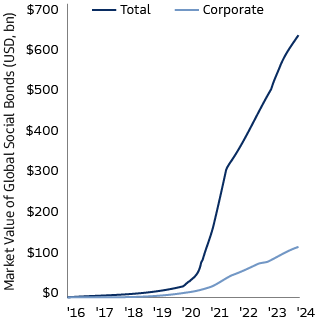
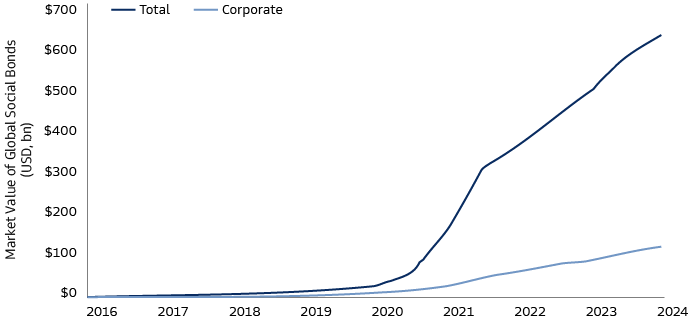
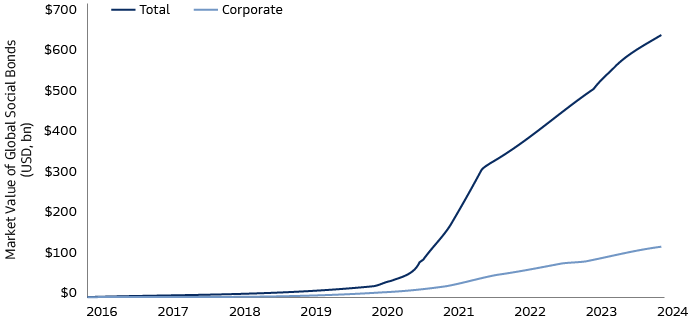
The social bond market has expanded to more than $630 billion in less than a decade, supported by strong investor demand.14 For issuers, tapping into this demand can provide a cost-effective way to raise funds to drive projects aimed at financial inclusion and other objectives.15 For investors, social bonds offer a way to advance their sustainability goals without sacrificing liquidity or returns. A key feature of social bonds is that their legal documentation spells out how their proceeds will be used, with the goal of financing only projects with clear social benefits. Issuers are also expected to report annually on the progress of projects financed with social bonds and the impact achieved.


The Global Social Bond Market Has Expanded to $639 Billion in Under a Decade 


Source: Goldman Sachs Asset Management, Bloomberg. As of December 31, 2023.


Connecting People With Finance in Emerging Markets

In emerging markets, the obstacles to financial inclusion are more extensive than in developed countries. Of the 1.4 billion adults worldwide who remained unbanked in 2021, nearly all of them lived in developing economies. As a result, just 57% of adults in developing economies made or received digital payments, compared with 95% in in high-income economies.16


Improving financial inclusion in these regions will depend on expanding ownership of transaction accounts, which allow people to receive salaries and remittances safely and securely. This is more than a convenience: these accounts open the door to more efficient saving, cheaper borrowing, obtaining insurance and investing in life-enhancing services such as health and education.


Where banks are scarce, the adoption of mobile financial services can be one of the most efficient solutions, allowing countries to leapfrog the traditional financial infrastructure of the developed world. In many cases, however, the first step is to increase digital connectivity. An estimated 2.9 billion people were still offline in 2021, with 1.7 billion in the Asia-Pacific region – mostly in China and India – and about 740 million in Africa.17 Huge disparities are also found between urban and rural areas.


Impact Equity: Building the Network

Investment strategies focused on achieving impact and returns in listed equities are helping address the connectivity gap and enhance financial inclusion around the world. To make a positive impact, companies need to offer unique, innovative products and services. Technology is at the core of this effort, as it is in developed economies, but the tasks in emerging markets often focus on building the infrastructure needed for mobile financial services to thrive.


One company, for example, is developing telecommunications infrastructure in sub-Saharan African countries from Madagascar to Senegal. It owns and operates more than 14,000 telecom towers and enables mobile network coverage for over 144 million people, especially in rural areas. This has made the company a key player in the roll-out of mobile service in Africa and an important enabler of digital inclusion.18


Another company is building on this infrastructure, providing affordable mobile services to 151 million customers in 14 African markets, including data customers and users of its mobile money business.19 Its target is to ensure that around 90% of the population in its markets have access to mobile network services by 2030. The company has also set financial inclusion targets, including boosting the number of women using its mobile money product.20


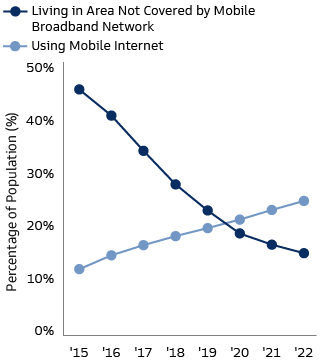
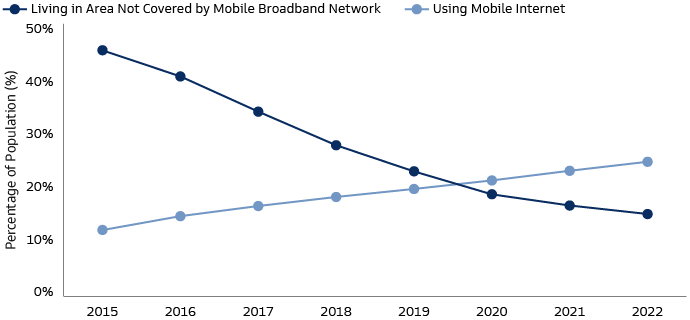
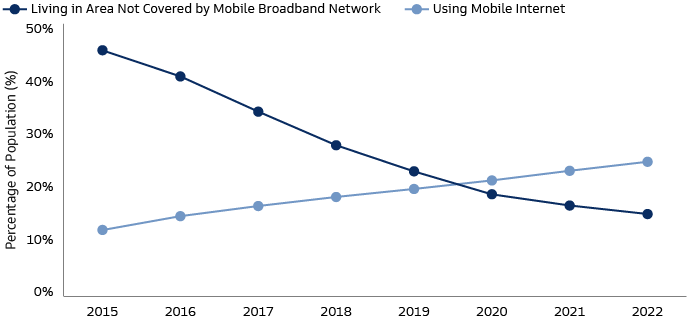
Narrowing the Mobile Coverage Gap in Sub-Saharan Africa 


Source: GSMA, Goldman Sachs Asset Management. Data as of December 31, 2022.21


Impact and Returns

The tech-driven revolution in financial services has transformed the market for investors seeking to promote financial inclusion and sustainable growth. In developed markets, fintech companies that make vital services affordable are expanding fast, demonstrating the viability of a business model based on bringing underserved groups into the financial system. In emerging markets, companies are successfully deploying technology to bring millions into the internet age and connect them to the financial grid through mobile services. And traditional financial firms are using innovative products like social bonds to raise funds earmarked for lending to low-income borrowers and small businesses. For investors, these companies show how far financial inclusion investment has come in recent years. Once viewed as concessionary investing, the market has progressed to the point where the dual goals of sustainable investing – social impact and returns – are increasingly aligned.


Related Insights

Start the Conversation

Committed to providing you with the insights you need to build your practice.


1The World Bank, for example, notes that ensuring universal and affordable access to financial services is a “key enabler” in the drive to reduce extreme poverty and increase shared prosperity. See “Financial Inclusion,” The World Bank website. As of February 6, 2023.

2 Ibid.

3 “Annual Report to the Secretary-General,” United Nations Secretary-General’s Special Advocate for Inclusive Finance for Development. As of September 2018. The 17 SDGs, adopted in 2015, are the core of the UN’s 15-year action plan for protecting the environment, ending poverty and reducing inequality.

4A FICO score is a brand of credit score used to predict the likelihood that a borrower will repay a loan on time. FICO stands for the Fair Isaac Corporation, a pioneer in developing a method for calculating a credit score based on the information collected by credit reporting agencies. See “What Is a FICO Score,” Consumer Financial Protection Bureau. As of September 4, 2020.

5 “FDIC National Survey of Unbanked and Underbanked Households,” FDIC. As of July 24, 2023. The products and services in question are: money orders, check cashing or international remittances (nonbank transactions); rent-to-own services or payday, pawn shop, tax refund anticipation or auto title loans (nonbank credit). The Federal Reserve has released more recent data on unbanked individuals, showing that 6% of US adults were “unbanked” in 2022, meaning neither they nor their spouse or partner had a checking, savings or money market account. See “Economic Well-Being of U.S. Households in 2022,” Board of Governors of the Federal Reserve System. As of May 2023.

6 “Overdraft Fees: Banks Must Stop Gouging Consumers During the COVID-19 Crisis,” Center for Responsible Lending. As of June 2020.

7“48 Percent of Americans With Annual Incomes Over $100,000 Live Paycheck to Paycheck, 9 Percentage Points Higher Than First Reported in June 2021,” LendingClub press release. As of March 3, 2022. Data as of January 2022.

8Company-reported information on its website. As of February 20, 2024.

9 “The European Small Business Finance Outlook 2023,” European Investment Fund Research and Market Analysis. As of December 2023.

10 “Access to Finance,” European Commission website. As of February 21, 2024. Globally, micro, small and medium-sized enterprises (MSMEs) account for 90% of businesses, more than 60% of employment and half of gross domestic product. See “Supporting small businesses to achieve inclusive growth for all,” UN Department of Economic and Social Affairs. As of June 27, 2023.

11 “The European Small Business Finance Outlook 2023,” European Investment Fund Research and Market Analysis. As of December 2023.

12Social bonds are fixed income securities with a social element. Their financial characteristics such as structure, risk and return are similar to those of conventional bonds. The main difference is that the legal documentation of social bonds spells out how their proceeds will be used, with the goal of financing only projects with clear social benefits such as building affordable housing, creating jobs and expanding access to education and healthcare. Most social bonds are also intended to make a positive impact on a specific population, such as the unemployed, undereducated and people living below the poverty line.

13 Company-reported information. As of December 2023.

14Goldman Sachs Asset Management, Bloomberg. As of January 31, 2024. Spain’s Instituto de Crédito Oficial (ICO), a state-owned investment bank, issued the first formal social bond in early 2015.

15Evidence of investor demand can be found in the order books of many social bond issues. For example, CADES – a French state agency and the largest issuer in the social bond market – sold a €5 billion social bond in early 2023. The order book for this issue totaled more than €31 billion, then a record level of interest in a bond issued by the agency. See “The Newsletter,” Number 46. CADES. As of February 2023. CADES (an acronym for Caisse d’amortissement de la dette sociale) was established by government order to redeem French social debt.

16 “The Global Findex Database 2021,” World Bank Group. As of June 2022.

17 “Global Connectivity Report 2022,” International Telecommunication Union. As of June 2022.

18Company-reported information on its website. As of February 22, 2024.

19 Company-reported information. As of December 31, 2023.

20Company-reported information. As of 2022.

21 “The State of Mobile Internet Connectivity Report 2023,” GSMA website. As of February 23, 2024. GSMA is the Global System for Mobile Association, an industry group representing the interests of mobile network operators. 


General Disclosures

Environmental, Social and Governance (“ESG”) strategies may take risks or eliminate exposures found in other strategies or broad market benchmarks that may cause performance to diverge from the performance of these other strategies or market benchmarks. ESG strategies will be subject to the risks associated with their underlying investments’ asset classes. Further, the demand within certain markets or sectors that an ESG strategy targets may not develop as forecasted or may develop more slowly than anticipated.

THIS MATERIAL DOES NOT CONSTITUTE AN OFFER OR SOLICITATION IN ANY JURISDICTION WHERE OR TO ANY PERSON TO WHOM IT WOULD BE UNAUTHORIZED OR UNLAWFUL TO DO SO.

Prospective investors should inform themselves as to any applicable legal requirements and taxation and exchange control regulations in the countries of their citizenship, residence or domicile which might be relevant.

This material is provided for informational purposes only and should not be construed as investment advice or an offer or solicitation to buy or sell securities. This material is not intended to be used as a general guide to investing, or as a source of any specific investment recommendations, and makes no implied or express recommendations concerning the manner in which any client’s account should or would be handled, as appropriate investment strategies depend upon the client’s investment objectives.

Past performance does not guarantee future results, which may vary. The value of investments and the income derived from investments will fluctuate and can go down as well as up. A loss of principal may occur.

This information discusses general market activity, industry or sector trends, or other broad-based economic, market or political conditions and should not be construed as research or investment advice. This material has been prepared by Goldman Sachs Asset Management and is not financial research nor a product of Goldman Sachs Global Investment Research (GIR). It was not prepared in compliance with applicable provisions of law designed to promote the independence of financial analysis and is not subject to a prohibition on trading following the distribution of financial research. The views and opinions expressed may differ from those of Goldman Sachs Global Investment Research or other departments or divisions of Goldman Sachs and its affiliates. Investors are urged to consult with their financial advisors before buying or selling any securities. This information may not be current and Goldman Sachs Asset Management has no obligation to provide any updates or changes.

Any reference to a specific company or security does not constitute a recommendation to buy, sell, hold or directly invest in the company or its securities. It should not be assumed that investment decisions made in the future will be profitable or will equal the performance of the securities discussed in this document.

Although certain information has been obtained from sources believed to be reliable, we do not guarantee its accuracy, completeness or fairness. We have relied upon and assumed without independent verification, the accuracy and completeness of all information available from public sources.

Views and opinions expressed are for informational purposes only and do not constitute a recommendation by Goldman Sachs Asset Management to buy, sell, or hold any security. Views and opinions are current as of the date of this presentation and may be subject to change, they should not be construed as investment advice.

There is no guarantee that objectives will be met.

United States: In the United States, this material is offered by and has been approved by Goldman Sachs Asset Management, L.P. and Goldman Sachs & Co. LLC, which are registered investment advisers with the Securities and Exchange Commission.  

United Kingdom: In the United Kingdom, this material is a financial promotion and has been approved by Goldman Sachs Asset Management International, which is authorized and regulated in the United Kingdom by the Financial Conduct Authority.

Denmark and Sweden:  This financial promotion is provided by Goldman Sachs Bank Europe SE. This material is a financial promotion disseminated by Goldman Sachs Bank Europe SE, including through its authorised branches ("GSBE"). GSBE is a credit institution incorporated in Germany and, within the Single Supervisory Mechanism established between those Member States of the European Union whose official currency is the Euro, subject to direct prudential supervision by the European Central Bank and in other respects supervised by German Federal Financial Supervisory Authority (Bundesanstalt für Finanzdienstleistungsaufischt, BaFin) and Deutsche Bundesbank.

This financial promotion is provided by Goldman Sachs Asset Management B.V.

European Economic Area (EEA): This marketing communication is disseminated by Goldman Sachs Asset Management B.V., including through its branches (“GSAM BV”). GSAM BV is authorised and regulated by the Dutch Authority for the Financial Markets (Autoriteit Financiële Markten, Vijzelgracht 50, 1017 HS Amsterdam, The Netherlands) as an alternative investment fund manager (“AIFM”) as well as a manager of undertakings for collective investment in transferable securities (“UCITS”). Under its licence as an AIFM, the Manager is authorized to provide the investment services of (i) reception and transmission of orders in financial instruments; (ii) portfolio management; and (iii) investment advice. Under its licence as a manager of UCITS, the Manager is authorized to provide the investment services of (i) portfolio management; and (ii) investment advice. Information about investor rights and collective redress mechanisms are available on www.gsam.com/responsible-investing (section Policies & Governance). Capital is at risk. Any claims arising out of or in connection with the terms and conditions of this disclaimer are governed by Dutch law.

Switzerland: For Qualified Investor use only – Not for distribution to general public. This is marketing material. This document is provided to you by Goldman Sachs Asset Management Schweiz Gmbh. Any future contractual relationships will be entered into with affiliates of Goldman Sachs Asset Management Schweiz Gmbh, which are domiciled outside of Switzerland. We would like to remind you that foreign (Non-Swiss) legal and regulatory systems may not provide the same level of protection in relation to client confidentiality and data protection as offered to you by Swiss law.

Asia excluding Japan: Please note that neither Goldman Sachs Asset Management (Hong Kong) Limited (“GSAMHK”) or Goldman Sachs Asset Management (Singapore) Pte. Ltd. (Company Number: 201329851H ) (“GSAMS”) nor any other entities involved in the Goldman Sachs Asset Management business that provide this material and information maintain any licenses, authorizations or registrations in Asia (other than Japan), except that it conducts businesses (subject to applicable local regulations) in and from the following jurisdictions: Hong Kong, Singapore, India and China. This material has been issued for use in or from Hong Kong by Goldman Sachs Asset Management (Hong Kong) Limited and in or from Singapore by Goldman Sachs Asset Management (Singapore) Pte. Ltd. (Company Number: 201329851H).

This material is distributed in Australia and New Zealand by Goldman Sachs Asset Management Australia Pty Ltd ABN 41 006 099 681, AFSL 228948 (’GSAMA’) and is intended for viewing only by wholesale clients in Australia for the purposes of section 761G of the Corporations Act 2001 (Cth) and to clients who either fall within any or all of the categories of investors set out in section 3(2) or sub-section 5(2CC) of the Securities Act 1978, fall within the definition of a wholesale client for the purposes of the Financial Service Providers (Registration and Dispute Resolution) Act 2008 (FSPA) and the Financial Advisers Act 2008 (FAA),and fall within the definition of a wholesale investor under one of clause 37, clause 38, clause 39 or clause 40 of Schedule 1 of the Financial Markets Conduct Act 2013 (FMCA) of New Zealand (collectively, a “NZ Wholesale Investor”). GSAMA is not a registered financial service provider under the FSPA. GSAMA does not have a place of business in New Zealand. In New Zealand, this document, and any access to it, is intended only for a person who has first satisfied GSAMA that the person is a NZ Wholesale Investor. This document is intended for viewing only by the intended recipient. This document may not be reproduced or distributed to any person in whole or in part without the prior written consent of GSAMA.

To the extent that this document contains any statement which may be considered to be financial product advice in Australia under the Corporations Act 2001 (Cth), that advice is intended to be given to the intended recipient of this document only, being a wholesale client for the purposes of the Corporations Act 2001 (Cth).

Any advice provided in this document is provided by either of the following entities. They are exempt from the requirement to hold an Australian financial services licence under the Corporations Act of Australia and therefore do not hold any Australian Financial Services Licences, and are regulated under their respective laws applicable to their jurisdictions, which differ from Australian laws. Any financial services given to any person by these entities by distributing this document in Australia are provided to such persons pursuant to the respective ASIC Class Orders and ASIC Instrument mentioned below.

  • Goldman Sachs Asset Management, LP (GSAMLP), Goldman Sachs & Co. LLC (GSCo), pursuant ASIC Class Order 03/1100; regulated by the US Securities and Exchange Commission under US laws.
  • Goldman Sachs Asset Management International (GSAMI), Goldman Sachs International (GSI), pursuant to ASIC Class Order 03/1099; regulated by the Financial Conduct Authority; GSI is also authorized by the Prudential Regulation Authority, and both entities are under UK laws.
  • Goldman Sachs Asset Management (Singapore) Pte. Ltd. (GSAMS), pursuant to ASIC Class Order 03/1102; regulated by the Monetary Authority of Singapore under Singaporean laws.
  • Goldman Sachs Asset Management (Hong Kong) Limited (GSAMHK), pursuant to ASIC Class Order 03/1103 and Goldman Sachs (Asia) LLC (GSALLC), pursuant to ASIC Instrument 04/0250; regulated by the Securities and Futures Commission of Hong Kong under Hong Kong laws.


No offer to acquire any interest in a fund or a financial product is being made to you in this document. If the interests or financial products do become available in the future, the offer may be arranged by GSAMA in accordance with section 911A(2)(b) of the Corporations Act. GSAMA holds Australian Financial Services Licence No. 228948. Any offer will only be made in circumstances where disclosure is not required under Part 6D.2 of the Corporations Act or a product disclosure statement is not required to be given under Part 7.9 of the Corporations Act (as relevant).

FOR DISTRIBUTION ONLY TO FINANCIAL INSTITUTIONS, FINANCIAL SERVICES LICENSEES AND THEIR ADVISERS. NOT FOR VIEWING BY RETAIL CLIENTS OR MEMBERS OF THE GENERAL PUBLIC.

Canada: This presentation has been communicated in Canada by GSAM LP, which is registered as a portfolio manager under securities legislation in all provinces of Canada and as a commodity trading manager under the commodity futures legislation of Ontario and as a derivatives adviser under the derivatives legislation of Quebec. GSAM LP is not registered to provide investment advisory or portfolio management services in respect of exchange-traded futures or options contracts in Manitoba and is not offering to provide such investment advisory or portfolio management services in Manitoba by delivery of this material.

Japan: This material has been issued or approved in Japan for the use of professional investors defined in Article 2 paragraph (31) of the Financial Instruments and Exchange Law (“FIEL”). Also, Any description regarding investment strategies on collective investment scheme under Article 2 paragraph (2) item 5 or item 6 of FIEL has been approved only for Qualified Institutional Investors defined in Article 10 of Cabinet Office Ordinance of Definitions under Article 2 of FIEL.

United Arab Emirates: This document has not been approved by, or filed with the Central Bank of the United Arab Emirates or the Securities and Commodities Authority. If you do not understand the contents of this document, you should consult with a financial advisor.

Saudi Arabia: The Capital Market Authority does not make any representation as to the accuracy or completeness of this document, and expressly disclaims any liability whatsoever for any loss arising from, or incurred in reliance upon, any part of this document. If you do not understand the contents of this document you should consult an authorised financial adviser.

These materials are presented to you by Goldman Sachs Saudi Arabia Company ("GSSA"). GSSA is authorised and regulated by the Capital Market Authority (“CMA”) in the Kingdom of Saudi Arabia. GSSA is subject to relevant CMA rules and guidance, details of which can be found on the CMA’s website at www.cma.org.sa.

The CMA does not make any representation as to the accuracy or completeness of these materials, and expressly disclaims any liability whatsoever for any loss arising from, or incurred in reliance upon, any part of these materials. If you do not understand the contents of these materials, you should consult an authorised financial adviser.

Kuwait: This material has not been approved for distribution in the State of Kuwait by the Ministry of Commerce and Industry or the Central Bank of Kuwait or any other relevant Kuwaiti government agency. The distribution of this material is, therefore, restricted in accordance with law no. 31 of 1990 and law no. 7 of 2010, as amended. No private or public offering of securities is being made in the State of Kuwait, and no agreement relating to the sale of any securities will be concluded in the State of Kuwait. No marketing, solicitation or inducement activities are being used to offer or market securities in the State of Kuwait.

Qatar: This document has not been, and will not be, registered with or reviewed or approved by the Qatar Financial Markets Authority, the Qatar Financial Centre Regulatory Authority or Qatar Central Bank and may not be publicly distributed. It is not for general circulation in the State of Qatar and may not be reproduced or used for any other purpose.

Bahrain: This material has not been reviewed by the Central Bank of Bahrain (CBB) and the CBB takes no responsibility for the accuracy of the statements or the information contained herein, or for the performance of the securities or related investment, nor shall the CBB have any liability to any person for damage or loss resulting from reliance on any statement or information contained herein. This material will not be issued, passed to, or made available to the public generally.

Oman: The Capital Market Authority of the Sultanate of Oman (the "CMA") is not liable for the correctness or adequacy of information provided in this document or for identifying whether or not the services contemplated within this document are appropriate investment for a potential investor. The CMA shall also not be liable for any damage or loss resulting from reliance placed on the document.

South Africa: Goldman Sachs Asset Management International is authorised by the Financial Services Board of South Africa as a financial services provider.

Israel: This document has not been, and will not be, registered with or reviewed or approved by the Israel Securities Authority (ISA”). It is not for general circulation in Israel and may not be reproduced or used for any other purpose. Goldman Sachs Asset Management International is not licensed to provide investment advisory or management services in Israel.

Jordan: The document has not been presented to, or approved by, the Jordanian Securities Commission or the Board for Regulating Transactions in Foreign Exchanges.

359638-OTU-1995936

Date of First Use: April 10, 2024

Please enter your email address to continue reading.

Confirm Your Access


An email has been sent to you to verify ownership of your email address.

Please verify the link in the email by clicking the confirmation button. Once completed, you will gain instant access to our insights.

If you did not receive the email from us please check your spam folder or try again.