





Menu Our services in the selected location:
  • No services available for your region.
Select Location:
Remember my selection
Your browser is out of date.

DUAL DYNAMICS: INVESTING IN AND WITH ARTIFICIAL INTELLIGENCE

April 10, 2024  |  10 Minute Read


Laurene Azoulay

Global Co-Head of Client Portfolio Management, Quantitative Investment Strategies

Laurene Azoulay

Sung Cho

Portfolio Manager, Fundamental Equity

Sung Cho

Brook Dane

Portfolio Manager, Fundamental Equity

Brook Dane

Dennis Walsh

Global Co-Head, Quantitative Investment Strategies

Dennis Walsh


Key Takeaways


  • Investing in AI
    Artificial intelligence is maturing, and its impact is widening. Investment opportunities range from firms building the necessary AI infrastructure to companies harnessing the power of data on which AI models are trained.


  • Investing with AI
    AI tools can be applied to gain an informational advantage in public equity markets. But understanding techniques for alpha generation, as well as AI’s potential limitations and risks, will be key. 


  • Navigating an AI Future
    Beyond factors that fall directly within the control of corporate and investment management teams, investors should prepare for potential twists and turns, including unexpected AI breakthroughs and geopolitical risks.

Generative artificial intelligence (AI) went mainstream in 2023. Enthusiasm over its potential impact on economies intensified. Debate grew over AI’s impact on corporate profitability. We expect AI to begin shifting from “excitement” to “deployment” in 2024 and believe investment opportunities will broaden as the technology disrupts entire industries. Investors will need clear strategies to find the next generation of AI winners and to understand and apply the technology themselves. A combination of investing in and with artificial intelligence—two distinct but interrelated approaches—may drive long-term outperformance, but the journey is likely to be complex and continuously evolving.


Still A Magnificent (7) Opportunity?

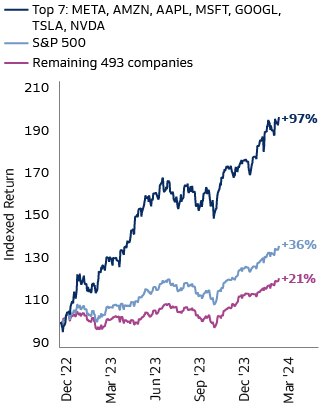
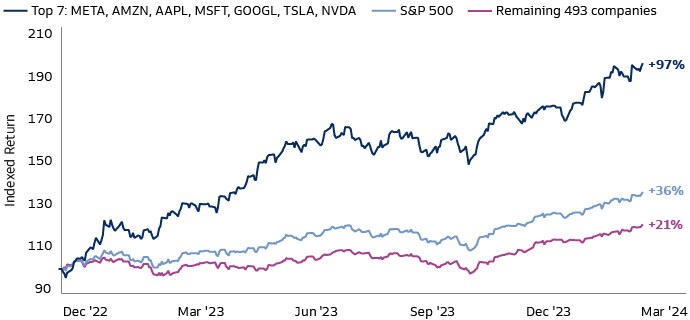
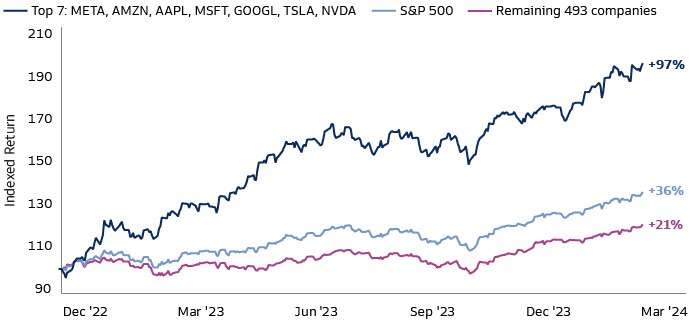
The surge of interest in AI fueled a major rally in technology stocks in 2023, with a concentrated group of large US companies leading the market higher. The so-called Magnificent 7 collectively drove 70% of the absolute performance of the Nasdaq Composite Index in 2023.1,2  The S&P 500 index returned 26% in 2023.3 Without the Magnificent 7, the index would have risen only 8%.4 The dominance of these names, primarily due to large increases in earnings driven by AI, has continued in the early part of 2024. Other quality attributes—including balance sheet strength, profit margins and size—have kept the group insulated from the impact of rising interest rates over the past two years.


The Magnificent 7 Are Driving the Bulk of Index Returns 


Source: FactSet, Goldman Sachs Global Investment Research. As of March 1, 2024. The economic and market forecasts presented herein are for informational purposes as of the date of this presentation. There can be no assurance that the forecasts will be achieved. Please see additional disclosures at the end of this presentation. Any reference to a specific company or security does not constitute a recommendation to buy, sell, hold or directly invest in the company or its securities.


A common pushback from investors to the Magnificent 7 relates to elevated valuations. In aggregate, the Magnificent 7 stocks trade at a forward price to earnings multiple of ~30x compared with ~18x for the remaining 493 S&P 500 companies.5 However, these seven names are expected to grow sales at 4x the rate of the other 493 companies through 2025.6 It is likely that the Magnificent 7 will continue to dominate headlines in 2024. Beyond these names, finding the next set of AI winners will require investors to apply a wider lens.


Investing across the market cap spectrum—both in developed and emerging markets—may prove rewarding in 2024 as AI innovation accelerates alongside changing macroeconomic conditions. For instance, further progress on disinflation and lower interest rates could act as a tailwind for overlooked tech firms, including small cap stocks with valuations at multi-decade lows. A closer look at AI’s impact on sectors, including new tools to strengthen cybersecurity or AI-powered drug discovery in healthcare, may also uncover unique opportunities.


More broadly, a focus on nations forging their own AI paths could prove rewarding. India and Japan, for example, stand to benefit from their advantageous macroeconomic positions as we head further into an AI world. Different geographies will have unique abilities to shape AI’s development and adoption, and risk tolerance will vary from country to country. Rising geopolitical risks and global supply chains will also influence AI’s evolution, along with political events, the roll out of incentives to boost AI investment, and regulatory responses to limit perceived AI risks.


Investing in AI – Enablers, Data and Applications

As AI alters economies and industries, the range of opportunities and risks will expand and dispersion between winners and losers will widen. A helpful starting point for investors seeking exposure to AI opportunities in public equity markets may be to categorize potential beneficiaries into three broad buckets—keeping in mind that across each area, alpha generation will likely be rooted in a focus on quality, bottom-up fundamental analysis, and active management.


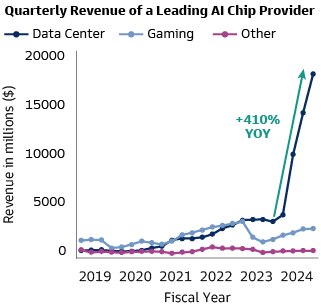
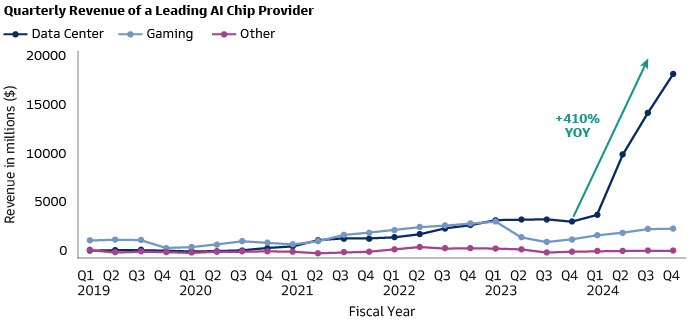
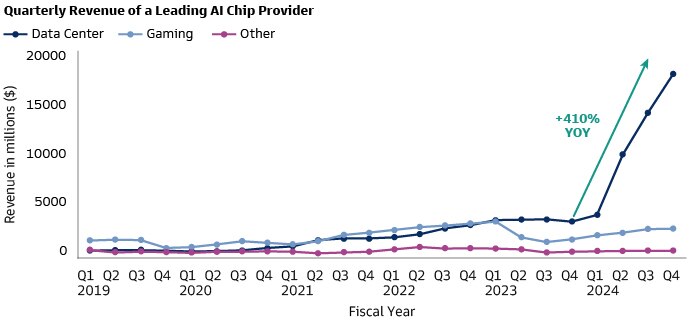
The first order beneficiaries of AI are what we call the “enablers”. This category includes companies building necessary AI infrastructure, such as semiconductor and semi-cap equipment manufacturers. The advent of commercially accessible large language models, such as ChatGPT, require significant computational power and memory. This has led to heightened demand for high-powered chips that only a handful of companies can currently design or manufacture. We believe enablers will be beneficiaries of increased investment from cloud vendors who are looking to diversify their supply of chips needed for AI as well as the buildout of data centers dedicated to AI. Active management is key when investing in this space due to the rapidly evolving opportunity set and changing risk-reward dynamics.


Enablers are Today’s AI Winners 


Source: Statista. As of February 2024. The economic and market forecasts presented herein are for informational purposes as of the date of this presentation. There can be no assurance that the forecasts will be achieved. Please see additional disclosures at the end of this presentation. 


As AI technologies mature and opportunities expand beyond “enablers”, tomorrow’s potential beneficiaries may be found in the “data and security” layer. The foundation of complex AI models is built upon the quality of the underlying data on which those models are trained. In addition to having a large quantity of data, the most insightful and accurate models learn from organized, accurate, and secure data. The rise of generative AI has sparked significant concerns about the impact of cybersecurity, driving demand for cutting-edge solutions. We believe companies across the tech ecosystem that can help other companies effectively protect and derive meaningful insights from their data will play an increasingly critical role. Firms that leverage data to enhance operational efficiency, better understand their customers, create more personalized experiences, and make better informed, data-driven decisions, stand to benefit.


Lastly, we believe the “applications”—software companies and firms across sectors leveraging AI to improve their products and services—will benefit in the years ahead, as AI becomes more specialized and domain-specific. With businesses seeking to embrace new technologies, software companies that provide an enhanced customer experience to help them adapt and maximize their value will be well-positioned. AI is also starting to transform other industries beyond tech, for example in healthcare, retail, and manufacturing. Many businesses have started to focus on AI integration, but we are at an early stage and there is still a long runway of growth ahead.


Investing With AI – Gaining an Edge in Equity Markets

While investors can choose to capitalize on the latest developments by deploying capital directly into AI-related opportunities, they can similarly benefit from evaluating how AI breakthroughs are helping to enhance investment management processes and investment decision-making. Using AI in systematic investing is not new, but today’s tools are far more powerful. Large language models are underpinned by “transformer technology”—the “T” in ChatGPT or in Google’s BERT. This technology introduces contextual relationships between words and documents in a way that is highly efficient and practical, allowing investors to train models using much more data than was computationally possible historically. What has resulted is really a stepwise increase in the power of these models.


Given the meaningful jump in efficacy of the latest models relative to prior techniques, we believe AI is becoming an increasingly important tool for investors to systematically extract information from the large, complex, and unstructured datasets and to inform investment decisions in public equity markets. For instance, financial news articles, earnings call transcripts, analyst research reports and regulatory filings are frequently used to complement financial metrics and market data. The exponential growth of this type of data will require new and robust techniques to extract meaningful insights and maintain an informational edge in markets. This can be particularly valuable when investing in larger, more dispersed markets, such as small caps or emerging market equities, which have persistent informational inefficiencies.


As the quantity of data continues to grow exponentially…

 

6.3mm

Google search queries conducted per minute7

20.8k

Average users on LinkedIn per minute8

$455k

Shoppers spent on Amazon per minute9


… we believe that AI is becoming increasingly important for investors to systematically extract information from the large, complex and unstructured datasets and to inform investment decisions in public equity markets.


Any reference to a specific company or security does not constitute a recommendation to buy, sell hold or directly invest in the company or its securities. For illustrative purposes only. The economic and market forecasts presented herein are for informational purposes as of the date of this presentation. There can be no assurance that the forecasts will be achieved. Please see additional disclosures at the end of this presentation. This is a marketing communication.  


Examples of new AI tools in action include large language models programmed to analyze tonal sentiment during earnings calls. In other words, signals detecting not just “what management is saying” but “how management is saying it”. Management that speaks with characteristics of confidence in their tone, for example, can implicitly be expressing a positive outlook for their company. Evasiveness of speech may correlate with the intent to avoid drawing attention to poor firm prospects. Deciphering a large amount of existing unstructured data can also help discover underappreciated thematic trends and economic relationships between companies that other investors may not see.


To effectively deploy AI and machine learning tools, practitioners should consider the use cases such that the underlying datasets justify the need for more robust data analysis techniques. Crucially, leveraging AI effectively requires the intellectual capital to not simply use technology, but an ability to understand the data, why to use it, and how. Finally, we expect investors who have access to resources and the infrastructure in place to harness data—including the compute power and processing capabilities to train large language models—will have a competitive advantage in the years ahead.


Navigating an AI Future

Beyond factors that fall directly within the control of corporate and investment management teams, unforeseen twists in AI development may shape macroeconomic and geopolitical dynamics. From a macroeconomic perspective, while AI has significant potential to boost economic growth and productivity, it may create labor displacement, rising inequality and structural unemployment. The timing and magnitude of such macro effects remain very uncertain and notoriously hard to predict.


On the geopolitical front, AI has the potential to revolutionize supply chain operations by improving efficiency, but it could also exacerbate mistrust between nations and accelerate economic fragmentation, including technology ecosystems between the US and China. As countries compete to secure the economic and geopolitical advantages of AI, we believe companies that successfully align themselves with corporate and government efforts to boost the security of supply chains and resources, as well as national security, may emerge as long-term winners.


A critical supply chain issue is that most of the world’s semiconductor manufacturing capacity is based in Asia. Taiwan dominates the manufacturing of high-end chips key for the next generation of AI technologies. Efforts by developed markets, including the US, EU, and Japan, to onshore, reshore, or nearshore semiconductor development and manufacturing—made possible by AI reducing labor costs—will create investment opportunities. In cybersecurity, while generative AI tools can help us predict, identify, and respond to security risks faster, they can also make cyberattacks easier to carry out and much more damaging. We expect significant investment in robust defense technologies and cybersecurity solutions in the years ahead.


The potential impact of AI in disrupting elections is another area for investors to watch out for. As a record number of countries go to the polls in 2024, misinformation and misuse of generative AI text, audio, and video content may influence outcomes of key policy votes by swaying public opinion or exacerbating societal divisions. And with democracies facing challenges on multiple fronts—including ongoing wars in Ukraine and the Middle East—this year is likely to provide a clearer picture of how AI can change the character of war and how democracies defend themselves.


Looking Ahead

The rapid rise and transformative potential of generative AI and machine learning puts the technology on a course to become the hallmark of the modern economy and financial markets. Predicting winners and losers and making the best use of AI is far from straightforward, particularly at this early stage in a new technology’s life cycle. There are also a myriad of unknowns, including geopolitical risks and potential for misuse of models, complicated regulatory issues, uncertain timelines for AI adoption and nascent monetization models yet to be proven. We expect the links between AI and investing to become even more intertwined as society and economies become more familiar with the technology. Investors who find ways to successfully balance the dual dynamics of investing in and with AI, while navigating an unpredictable AI future, are likely to be among the long-term winners.


Related Insights

Start the Conversation

Committed to providing you with the insights you need to build your practice.


1Magnificent 7 refers to Nvidia, Microsoft, Google, Meta, Tesla, Apple, and Amazon

2FactSet, Goldman Sachs Asset Management. As of December 31, 2023.

3FactSet. As of December 31, 2023.

4Bloomberg, FactSet. As of December 31, 2023.

5FactSet, Goldman Sachs Global Investment Research. As of February 29, 2024.

6Source: FactSet, Goldman Sachs Global Investment Research. As of February 29, 2024. Bottom-up consensus 2023-25E sales compound annual growth rate (CAGR).

7LocaliQ. As of December 4, 2023.

8LocaliQ. As of December 4, 2023.

9Domo. As of December 14, 2023.

Risk Disclosures

Hedge funds and other private investment funds (collectively, “Alternative Investments”) are subject to less regulation than other types of pooled investment vehicles such as mutual funds. Alternative Investments may impose significant fees, including incentive fees that are based upon a percentage of the realized and unrealized gains and an individual’s net returns may differ significantly from actual returns. Such fees may offset all or a significant portion of such Alternative Investment’s trading profits. Alternative Investments are not required to provide periodic pricing or valuation information. Investors may have limited rights with respect to their investments, including limited voting rights and participation in the management of such Alternative Investments.

Alternative Investments often engage in leverage and other investment practices that are extremely speculative and involve a high degree of risk. Such practices may increase the volatility of performance and the risk of investment loss, including the loss of the entire amount that is invested. There may be conflicts of interest relating to the Alternative Investment and its service providers, including Goldman Sachs and its affiliates. Similarly, interests in an Alternative Investment are highly illiquid and generally are not transferable without the consent of the sponsor, and applicable securities and tax laws will limit transfers.

Conflicts of Interest

There may be conflicts of interest relating to the Alternative Investment and its service providers, including Goldman Sachs and its affiliates. These activities and interests include potential multiple advisory, transactional and other interests in securities and instruments that may be purchased or sold by the Alternative Investment. These are considerations of which investors should be aware and additional information relating to these conflicts is set forth in the offering materials for the Alternative Investment.

Equity investments are subject to market risk, which means that the value of the securities in which it invests may go up or down in response to the prospects of individual companies, particular sectors and/or general economic conditions. Different investment styles (e.g., “growth” and “value”) tend to shift in and out of favor, and, at times, the strategy may underperform other strategies that invest in similar asset classes. The market capitalization of a company may also involve greater risks (e.g. "small" or "mid" cap companies) than those associated with larger, more established companies and may be subject to more abrupt or erratic price movements, in addition to lower liquidity.

Investments in fixed income securities are subject to the risks associated with debt securities generally, including credit, liquidity, interest rate, prepayment and extension risk. Bond prices fluctuate inversely to changes in interest rates. Therefore, a general rise in interest rates can result in the decline in the bond’s price.  The value of securities with variable and floating interest rates are generally less sensitive to interest rate changes than securities with fixed interest rates. Variable and floating rate securities may decline in value if interest rates do not move as expected. Conversely, variable and floating rate securities will not generally rise in value if market interest rates decline. Credit risk is the risk that an issuer will default on payments of interest and principal. Credit risk is higher when investing in high yield bonds, also known as junk bonds. Prepayment risk is the risk that the issuer of a security may pay off principal more quickly than originally anticipated. Extension risk is the risk that the issuer of a security may pay off principal more slowly than originally anticipated. All fixed income investments may be worth less than their original cost upon redemption or maturity.

General Disclosures

References to indices, benchmarks or other measures of relative market performance over a specified period of time are provided for your information only and do not imply that the portfolio will achieve similar results. The index composition may not reflect the manner in which a portfolio is constructed. While an adviser seeks to design a portfolio which reflects appropriate risk and return features, portfolio characteristics may deviate from those of the benchmark

This material is provided at your request for informational purposes only. It is not an offer or solicitation to buy or sell any securities.

Economic and market forecasts presented herein reflect a series of assumptions and judgments as of the date of this presentation and are subject to change without notice. These forecasts do not take into account the specific investment objectives, restrictions, tax and financial situation or other needs of any specific client. Actual data will vary and may not be reflected here. These forecasts are subject to high levels of uncertainty that may affect actual performance. Accordingly, these forecasts should be viewed as merely representative of a broad range of possible outcomes. These forecasts are estimated, based on assumptions, and are subject to significant revision and may change materially as economic and market conditions change. Goldman Sachs has no obligation to provide updates or changes to these forecasts. Case studies and examples are for illustrative purposes only.

THIS MATERIAL DOES NOT CONSTITUTE AN OFFER OR SOLICITATION IN ANY JURISDICTION WHERE OR TO ANY PERSON TO WHOM IT WOULD BE UNAUTHORIZED OR UNLAWFUL TO DO SO.

Prospective investors should inform themselves as to any applicable legal requirements and taxation and exchange control regulations in the countries of their citizenship, residence or domicile which might be relevant.

This material is provided for informational purposes only and should not be construed as investment advice or an offer or solicitation to buy or sell securities. This material is not intended to be used as a general guide to investing, or as a source of any specific investment recommendations, and makes no implied or express recommendations concerning the manner in which any client’s account should or would be handled, as appropriate investment strategies depend upon the client’s investment objectives.

Index Benchmarks

Indices are unmanaged. The figures for the index reflect the reinvestment of all income or dividends, as applicable, but do not reflect the deduction of any fees or expenses which would reduce returns. Investors cannot invest directly in indices.

The indices referenced herein have been selected because they are well known, easily recognized by investors, and reflect those indices that the Investment Manager believes, in part based on industry practice, provide a suitable benchmark against which to evaluate the investment or broader market described herein.

Past performance does not guarantee future results, which may vary. The value of investments and the income derived from investments will fluctuate and can go down as well as up. A loss of principal may occur.

This information discusses general market activity, industry or sector trends, or other broad-based economic, market or political conditions and should not be construed as research or investment advice. This material has been prepared by Goldman Sachs Asset Management and is not financial research nor a product of Goldman Sachs Global Investment Research (GIR). It was not prepared in compliance with applicable provisions of law designed to promote the independence of financial analysis and is not subject to a prohibition on trading following the distribution of financial research. The views and opinions expressed may differ from those of Goldman Sachs Global Investment Research or other departments or divisions of Goldman Sachs and its affiliates. Investors are urged to consult with their financial advisors before buying or selling any securities. This information may not be current and Goldman Sachs Asset Management has no obligation to provide any updates or changes.

Any reference to a specific company or security does not constitute a recommendation to buy, sell, hold or directly invest in the company or its securities. It should not be assumed that investment decisions made in the future will be profitable or will equal the performance of the securities discussed in this document.

Although certain information has been obtained from sources believed to be reliable, we do not guarantee its accuracy, completeness or fairness. We have relied upon and assumed without independent verification, the accuracy and completeness of all information available from public sources.

Views and opinions expressed are for informational purposes only and do not constitute a recommendation by Goldman Sachs Asset Management to buy, sell, or hold any security. Views and opinions are current as of the date of this presentation and may be subject to change, they should not be construed as investment advice.

There is no guarantee that objectives will be met.

United States: In the United States, this material is offered by and has been approved by Goldman Sachs Asset Management, L.P. and Goldman Sachs & Co. LLC, which are registered investment advisers with the Securities and Exchange Commission.  

United Kingdom: In the United Kingdom, this material is a financial promotion and has been approved by Goldman Sachs Asset Management International, which is authorized and regulated in the United Kingdom by the Financial Conduct Authority.

Denmark and Sweden:  This financial promotion is provided by Goldman Sachs Bank Europe SE. This material is a financial promotion disseminated by Goldman Sachs Bank Europe SE, including through its authorised branches ("GSBE"). GSBE is a credit institution incorporated in Germany and, within the Single Supervisory Mechanism established between those Member States of the European Union whose official currency is the Euro, subject to direct prudential supervision by the European Central Bank and in other respects supervised by German Federal Financial Supervisory Authority (Bundesanstalt für Finanzdienstleistungsaufischt, BaFin) and Deutsche Bundesbank.

This financial promotion is provided by Goldman Sachs Asset Management B.V.

European Economic Area (EEA): This marketing communication is disseminated by Goldman Sachs Asset Management B.V., including through its branches (“GSAM BV”). GSAM BV is authorised and regulated by the Dutch Authority for the Financial Markets (Autoriteit Financiële Markten, Vijzelgracht 50, 1017 HS Amsterdam, The Netherlands) as an alternative investment fund manager (“AIFM”) as well as a manager of undertakings for collective investment in transferable securities (“UCITS”). Under its licence as an AIFM, the Manager is authorized to provide the investment services of (i) reception and transmission of orders in financial instruments; (ii) portfolio management; and (iii) investment advice. Under its licence as a manager of UCITS, the Manager is authorized to provide the investment services of (i) portfolio management; and (ii) investment advice. Information about investor rights and collective redress mechanisms are available on www.gsam.com/responsible-investing (section Policies & Governance). Capital is at risk. Any claims arising out of or in connection with the terms and conditions of this disclaimer are governed by Dutch law.

Switzerland: For Qualified Investor use only – Not for distribution to general public. This is marketing material. This document is provided to you by Goldman Sachs Asset Management Schweiz Gmbh. Any future contractual relationships will be entered into with affiliates of Goldman Sachs Asset Management Schweiz Gmbh, which are domiciled outside of Switzerland. We would like to remind you that foreign (Non-Swiss) legal and regulatory systems may not provide the same level of protection in relation to client confidentiality and data protection as offered to you by Swiss law.

Asia excluding Japan: Please note that neither Goldman Sachs Asset Management (Hong Kong) Limited (“GSAMHK”) or Goldman Sachs Asset Management (Singapore) Pte. Ltd. (Company Number: 201329851H ) (“GSAMS”) nor any other entities involved in the Goldman Sachs Asset Management business that provide this material and information maintain any licenses, authorizations or registrations in Asia (other than Japan), except that it conducts businesses (subject to applicable local regulations) in and from the following jurisdictions: Hong Kong, Singapore, India and China. This material has been issued for use in or from Hong Kong by Goldman Sachs Asset Management (Hong Kong) Limited and in or from Singapore by Goldman Sachs Asset Management (Singapore) Pte. Ltd. (Company Number: 201329851H).

This material is distributed in Australia and New Zealand by Goldman Sachs Asset Management Australia Pty Ltd ABN 41 006 099 681, AFSL 228948 (’GSAMA’) and is intended for viewing only by wholesale clients in Australia for the purposes of section 761G of the Corporations Act 2001 (Cth) and to clients who either fall within any or all of the categories of investors set out in section 3(2) or sub-section 5(2CC) of the Securities Act 1978, fall within the definition of a wholesale client for the purposes of the Financial Service Providers (Registration and Dispute Resolution) Act 2008 (FSPA) and the Financial Advisers Act 2008 (FAA),and fall within the definition of a wholesale investor under one of clause 37, clause 38, clause 39 or clause 40 of Schedule 1 of the Financial Markets Conduct Act 2013 (FMCA) of New Zealand (collectively, a “NZ Wholesale Investor”). GSAMA is not a registered financial service provider under the FSPA. GSAMA does not have a place of business in New Zealand. In New Zealand, this document, and any access to it, is intended only for a person who has first satisfied GSAMA that the person is a NZ Wholesale Investor. This document is intended for viewing only by the intended recipient. This document may not be reproduced or distributed to any person in whole or in part without the prior written consent of GSAMA.

To the extent that this document contains any statement which may be considered to be financial product advice in Australia under the Corporations Act 2001 (Cth), that advice is intended to be given to the intended recipient of this document only, being a wholesale client for the purposes of the Corporations Act 2001 (Cth).

Any advice provided in this document is provided by either of the following entities. They are exempt from the requirement to hold an Australian financial services licence under the Corporations Act of Australia and therefore do not hold any Australian Financial Services Licences, and are regulated under their respective laws applicable to their jurisdictions, which differ from Australian laws. Any financial services given to any person by these entities by distributing this document in Australia are provided to such persons pursuant to the respective ASIC Class Orders and ASIC Instrument mentioned below.

  • Goldman Sachs Asset Management, LP (GSAMLP), Goldman Sachs & Co. LLC (GSCo), pursuant ASIC Class Order 03/1100; regulated by the US Securities and Exchange Commission under US laws.
  • Goldman Sachs Asset Management International (GSAMI), Goldman Sachs International (GSI), pursuant to ASIC Class Order 03/1099; regulated by the Financial Conduct Authority; GSI is also authorized by the Prudential Regulation Authority, and both entities are under UK laws.
  • Goldman Sachs Asset Management (Singapore) Pte. Ltd. (GSAMS), pursuant to ASIC Class Order 03/1102; regulated by the Monetary Authority of Singapore under Singaporean laws.
  • Goldman Sachs Asset Management (Hong Kong) Limited (GSAMHK), pursuant to ASIC Class Order 03/1103 and Goldman Sachs (Asia) LLC (GSALLC), pursuant to ASIC Instrument 04/0250; regulated by the Securities and Futures Commission of Hong Kong under Hong Kong laws.


No offer to acquire any interest in a fund or a financial product is being made to you in this document. If the interests or financial products do become available in the future, the offer may be arranged by GSAMA in accordance with section 911A(2)(b) of the Corporations Act. GSAMA holds Australian Financial Services Licence No. 228948. Any offer will only be made in circumstances where disclosure is not required under Part 6D.2 of the Corporations Act or a product disclosure statement is not required to be given under Part 7.9 of the Corporations Act (as relevant).

FOR DISTRIBUTION ONLY TO FINANCIAL INSTITUTIONS, FINANCIAL SERVICES LICENSEES AND THEIR ADVISERS. NOT FOR VIEWING BY RETAIL CLIENTS OR MEMBERS OF THE GENERAL PUBLIC.

Canada: This presentation has been communicated in Canada by GSAM LP, which is registered as a portfolio manager under securities legislation in all provinces of Canada and as a commodity trading manager under the commodity futures legislation of Ontario and as a derivatives adviser under the derivatives legislation of Quebec. GSAM LP is not registered to provide investment advisory or portfolio management services in respect of exchange-traded futures or options contracts in Manitoba and is not offering to provide such investment advisory or portfolio management services in Manitoba by delivery of this material.

Japan: This material has been issued or approved in Japan for the use of professional investors defined in Article 2 paragraph (31) of the Financial Instruments and Exchange Law (“FIEL”). Also, Any description regarding investment strategies on collective investment scheme under Article 2 paragraph (2) item 5 or item 6 of FIEL has been approved only for Qualified Institutional Investors defined in Article 10 of Cabinet Office Ordinance of Definitions under Article 2 of FIEL.

United Arab Emirates: This document has not been approved by, or filed with the Central Bank of the United Arab Emirates or the Securities and Commodities Authority. If you do not understand the contents of this document, you should consult with a financial advisor.

Saudi Arabia: The Capital Market Authority does not make any representation as to the accuracy or completeness of this document, and expressly disclaims any liability whatsoever for any loss arising from, or incurred in reliance upon, any part of this document. If you do not understand the contents of this document you should consult an authorised financial adviser.

These materials are presented to you by Goldman Sachs Saudi Arabia Company ("GSSA"). GSSA is authorised and regulated by the Capital Market Authority (“CMA”) in the Kingdom of Saudi Arabia. GSSA is subject to relevant CMA rules and guidance, details of which can be found on the CMA’s website at www.cma.org.sa.

The CMA does not make any representation as to the accuracy or completeness of these materials, and expressly disclaims any liability whatsoever for any loss arising from, or incurred in reliance upon, any part of these materials. If you do not understand the contents of these materials, you should consult an authorised financial adviser.

Kuwait: This material has not been approved for distribution in the State of Kuwait by the Ministry of Commerce and Industry or the Central Bank of Kuwait or any other relevant Kuwaiti government agency. The distribution of this material is, therefore, restricted in accordance with law no. 31 of 1990 and law no. 7 of 2010, as amended. No private or public offering of securities is being made in the State of Kuwait, and no agreement relating to the sale of any securities will be concluded in the State of Kuwait. No marketing, solicitation or inducement activities are being used to offer or market securities in the State of Kuwait.

Qatar: This document has not been, and will not be, registered with or reviewed or approved by the Qatar Financial Markets Authority, the Qatar Financial Centre Regulatory Authority or Qatar Central Bank and may not be publicly distributed. It is not for general circulation in the State of Qatar and may not be reproduced or used for any other purpose.

Bahrain: This material has not been reviewed by the Central Bank of Bahrain (CBB) and the CBB takes no responsibility for the accuracy of the statements or the information contained herein, or for the performance of the securities or related investment, nor shall the CBB have any liability to any person for damage or loss resulting from reliance on any statement or information contained herein. This material will not be issued, passed to, or made available to the public generally.

Oman: The Capital Market Authority of the Sultanate of Oman (the "CMA") is not liable for the correctness or adequacy of information provided in this document or for identifying whether or not the services contemplated within this document are appropriate investment for a potential investor. The CMA shall also not be liable for any damage or loss resulting from reliance placed on the document.

South Africa: Goldman Sachs Asset Management International is authorised by the Financial Services Board of South Africa as a financial services provider.

Israel: This document has not been, and will not be, registered with or reviewed or approved by the Israel Securities Authority (ISA”). It is not for general circulation in Israel and may not be reproduced or used for any other purpose. Goldman Sachs Asset Management International is not licensed to provide investment advisory or management services in Israel.

Jordan: The document has not been presented to, or approved by, the Jordanian Securities Commission or the Board for Regulating Transactions in Foreign Exchanges.

360440-OTU-1993439

Date of First Use: April 10, 2024

Please enter your email address to continue reading.

Confirm Your Access


An email has been sent to you to verify ownership of your email address.

Please verify the link in the email by clicking the confirmation button. Once completed, you will gain instant access to our insights.

If you did not receive the email from us please check your spam folder or try again.