


 Tool
Tool
Menu
Our services in the selected location:
- No services available for your region.
Your browser is out of date.


-
In The Spotlight
Alternatives - Private Credit
Investing globally and across the capital structure, our private credit platform combines deep expertise and long-standing relationships with high caliber sponsors globally with the goal of identifying attractive risk-adjusted return opportunities across the credit spectrum.Read More -
-
- By Asset Class
-
Fixed Income
-
Equities
-
Alternatives
In The Spotlight
Perspectives
In this edition of Perspectives, we explore how investors can seek out potential opportunities across public and private markets as confidence in the macroeconomic outlook continues to build.Read More -
-
- Product Collateral
-
Product Brochures
-
Investment Solutions
-
Fact Cards
-
Fund Commentaries
-
- Documents and Forms
-
Tax Information
-
Forms & Applications
-
Regulatory Documents
-
All Documents
In The Spotlight
Our In-Depth Commentary Could Help You Gain a Competitive Edge
Read MoreStay on top of the latest market developments, key themes, and investment ideas affecting your portfolio and practices.
-
-
-
- About Us
-
Overview
-
News and Media
-
Contact Us
-
-
Explore how we can help you
Contact Us13 Years
Average Experience Across Muni Team
$110B
Municipal Assets Under Supervision in Separate Accounts
As of December 31, 2023
Two Core Offerings. One Powerful Approach
The Fixed Income Tax-Aware separately managed account (SMA) blends two core Goldman Sachs offerings: municipals and corporate fixed income. The strategy offers broad, investment-grade exposure with prudent risk oversight and access to a tenured team that manages more than $159 billion of municipal assets, including $110 billion in separately managed accounts.
Get quick details and information about this SMA solution.
How It Works
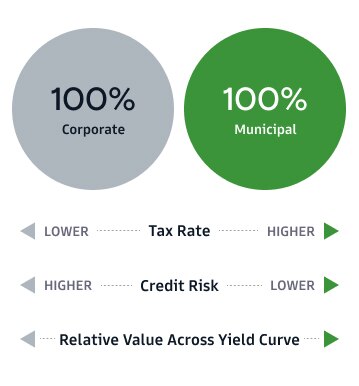
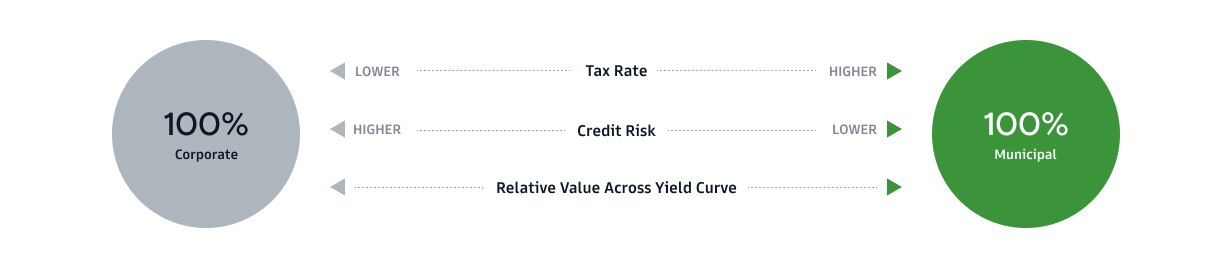
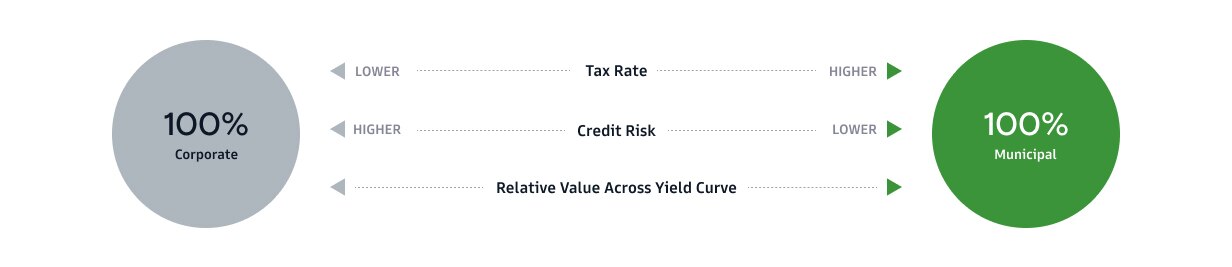
Leveraging decades of fixed income experience, our investment team aims to offer enhanced after-tax yields with a tailored approach to asset allocation that takes into account an individual's tax rate, credit risk considerations, and relative value across the investment-grade fixed income markets.
Investment Allocation Range
Implementation
An optimization engine will assess relative value across various fixed income markets in combination with an individual’s tax rate to create customized asset allocations within a standardized risk framework.
Portfolio Composition
A blend of taxable and tax-exempt investment grade fixed income securities, primarily comprised of corporate and municipal bonds.
Interest Rate Risk
Laddered short- and intermediate-duration portfolios with duration targets of either 3 or 4.5 years.
Credit Quality
Securities rated investment grade at time of purchase. Portfolio aims to maintain at least an A3/A-average credit rating.
Tax Efficiency
Seeks to maximize tax efficiency by accounting for state and federal tax rates when making investment decisions, while also limiting taxable consequences and tax-loss harvesting when appropriate.
Relative Value
Flexibility to take advantage of relative value opportunities within the tax-exempt and taxable municipal bond market in addition to corporate bonds to enhance after-tax yield.
Navigating a Complex Landscape.
Looking across various fixed income asset classes could improve after-tax income and offer diversification benefits – as different segments of the market deliver varying degrees of risk, return, and income over time. We believe it’s important for investors to work with an active manager that has the flexibility to navigate these evolving market dynamics.
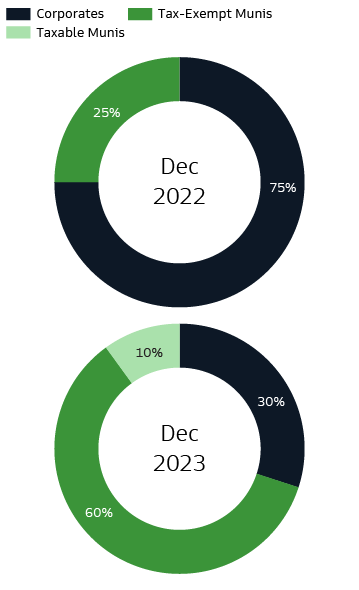
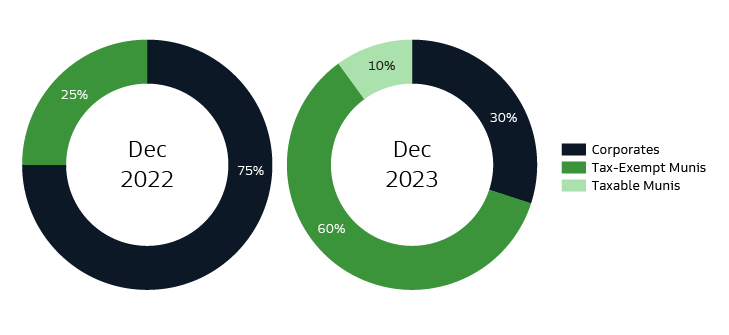
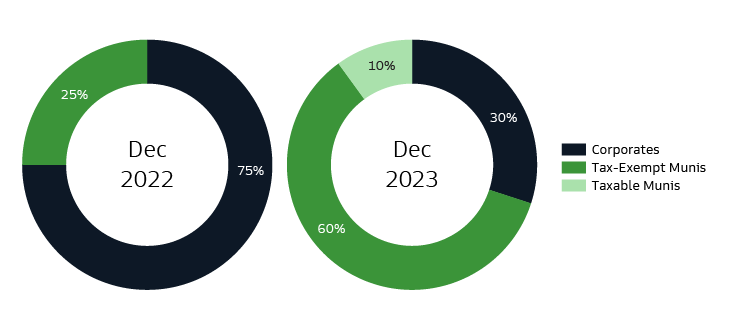
Illustrative Portfolio (40.8% Tax Rate)
Customized portfolios offer enhanced after-tax income potential by considering both an individual's federal tax rate and current relative value between investment-grade municipals and taxable bonds.
Start the Conversation
Connect with our team and learn more about our Fixed Income Tax Aware SMA.
Who It's For
Management Team
Tenured. Agile. Disciplined. Goldman Sachs Asset Management offers access to an industry-leading portfolio management team with the flexibility and expertise to navigate today’s complex fixed-income market.

Scott DiamondCo-Head of Municipal Fixed Income. 28 years of experience Scott Diamond
Scott joined Goldman Sachs Asset Management in 2002 as a senior portfolio manager working with high net worth and institutional clients. Before joining Goldman Sachs, Scott spent nine years at Prudential Financial, where he served as a portfolio manager for various national and state specific municipal mutual funds and institutional accounts. He also worked as a municipal trader and credit research analyst. Scott received his B.A. in Psychology from Rutgers University in 1989, his M.B.A. from Seton Hall University in 1993, and was awarded his CFA designation in 1998. |

Sylvia YehCo-Head of Municipal Fixed Income. 23 years of experience Sylvia Yeh
Prior to her current role, Sylvia was head of Municipal Fixed Income for Private Wealth Management in the Investment Management Division, where she built separately managed municipal bond portfolios for high net worth individuals and family offices. Sylvia was also a member of the Private Wealth Management Best Execution Committee. Before that, she spent 13 years as a municipal bond trader and salesperson within the Securities Division. Sylvia joined Goldman Sachs in 1999 and was named managing director in 2015. She earned a BS in Finance from The State University of New York at Albany in 1997. |

David AlterHead of Credit Research. 31 years of experience David Alter
David manages the Municipal Research team and is responsible for municipal credit decisions for mutual funds, individual accounts and institutional investments managed by the Municipal Fixed Income team. Before 2002, he did research in support of municipal banking and trading for the Goldman Sachs credit department. David started his career in the Public Finance Department at Moody’s Investors Service. He is a member of the Municipal Analyst Group of New York and earned his BA in Economics from the City University of New York in 1989. |

Ed PaulinskiHead of Municipal Separately Managed Accounts. 19 years of experience Ed Paulinski
Ed heads Goldman Sachs Asset Management’s Municipal Separately Managed Accounts (SMA) platform. He joined the company in 2014 as a portfolio manager in Private Wealth Management. Prior to that, he spent 12 years managing municipal bond portfolios at Western Asset Management with a focus on the firm’s separately managed account business. Ed received his B.A. in Economics from the State University of New York at New Paltz in 2002 and his M.B.A. from Baruch College in 2008. |
What is duration?
Duration is the method of determining a bond’s price sensitivity given a change in interest rates. The duration for fixed income securities is calculated by determining the price movement due to a 100 basis point change in market interest rates. This calculation incorporates the change in value of any embedded options that exist.
Are these portfolios actively managed?
Goldman Sachs Separately Managed Accounts are actively managed by our tenured team of investment professionals.
What is volatility?
Volatility is a measure for variation of price of a financial instrument over time.
What is the minimum account size for this strategy?
The minimum account size for this strategy is $250,000.
What is the credit quality rating?
A credit quality rating assesses the financial ability of a debt issuer to make timely payments of principal and interest. Ratings of AAA (the highest), AA, A, and BBB are investment-grade quality. Ratings of BB, B, CCC, CC, C and D (the lowest) are considered below investment grade, speculative grade, or junk bonds.
How do I get started?
To get started, contact a member of our team.
Resources & Insights
-
Tool
-
Municipal Bonds
Visit the GSAM Muni Center – where you can find our municipal bond funds and high caliber market insights. Read More -
Separately Managed Accounts
Goldman Sachs Asset Management Separately Managed Accounts (SMAs) offer customized investment solutions to fit your clients' unique needs Read More
×
