


Menu Our services in the selected location:
  • No services available for your region.
Select Location:
Remember my selection
Your browser is out of date.
MARKET KNOW-HOW 
|
4Q 2023

MARKET KNOW-HOW | 4Q 2023

Micro-Scope


Market Know-How 4Q 2023

Many predicted a technical recession, earnings recession, or both heading into this year, reflected by portfolios positioned tactically defensive. In reality, growth has surprised to the upside, inflation has moderated, and investor sentiment has been overtly risk on. Though the direction of monetary policy remains uncertain, growth risks have partially faded, and thus, we feel that now is the time to focus on long-term positioning.

Unexpected strong market returns have been driven in part by a seminal moment in technology: the advent of generative artificial intelligence. The recent run-up in equities informs our view, however, that markets may be pricing in perfection. While mega-cap tech stocks have been those commanding headlines of today, strategic thinking in other asset classes may generate returns of tomorrow.

In recent years, strong performance may have been generated by viewing the investment landscape through a telescope and positioning around macro trends. But now more than ever, we see the need for analyzing and building portfolios with a microscope. In our view, the next investment cycle will be defined by micro differentiation, enhanced risk-awareness, and an increased focus on alpha.

In this edition of the Market Know-How, we explore how investors may consider participation in a global recovery while maintaining a focus on risk management, with emphasis on:

  • Extending duration with the goal of hedging against the risk of an equity market drawdown.
  • Positioning for a broadening equity market while taking advantage of an attractive entry point in US small caps.
  • Diversifying public market exposures and seeking a balanced return distribution via private real estate.

Macro & Market Views


Economic Resilience

The soft landing narrative has strengthened in the US, as hard data have materially improved. We expect resilience in US growth but acknowledge pockets of economic deterioration and the fluidity of current macro conditions. The Euro area has continued to skirt recession, but it is not yet out of the woods: we think energy risks will re-emerge and greater disinflation progress will be needed. Meanwhile, China’s growth has disappointed, and concerns over a balance sheet recession are justified, in our view. Finally, Japan’s modest inflation suggests to us modest growth ahead. Still, we conclude that uncertainty will remain high across and within regions given variable transmission of monetary policy.

Source: Goldman Sachs Global Investment Research and Goldman Sachs Asset Management. As of September 13, 2023. “Soft landing” refers to an environment in which the Federal Reserve tightens monetary policy to fight inflation without causing a US recession. “Balance sheet recession” refers to a situation in which households and businesses divert more of their income toward paying down debt, rather than consuming or investing. “Real GDP” refers to Gross Domestic Product adjusted for inflation, year-over-year. Real GDP growth forecasts are sourced from Goldman Sachs Global Investment Research. “A” refers to actual. “E” refers to expected. The economic and market forecasts presented herein are for informational purposes as of the date of this publication. There can be no assurance that the forecasts will be achieved. Please see additional disclosures at the end of this publication. Past performance does not guarantee future results, which may vary.
VIEW LESS DISCLOSURE
Outlook
Duration Extension: Return of Asymmetry

Better Return Asymmetry

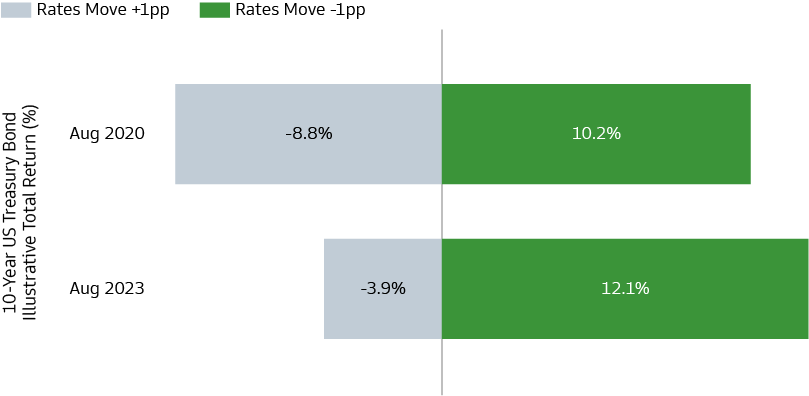
While many investors understand the appeal of extending duration, we believe few have truly returned to their strategic portfolio weights in light of elevated cash yields. However, we espouse a new angle to core fixed income: beyond attractive yields, modest expected spread tightening, and a normalizing equity/bond return correlation, we find that implied return asymmetry in intermediate-duration bonds has significantly improved relative to the zero-interest rate world of 2020. In other words, we find that bond prices today are theoretically punished less if rates rise, and more importantly, that they are theoretically rewarded more if rates fall, which is more likely today vis-Ă -vis pre-pandemic.


Source: Bloomberg and Goldman Sachs Asset Management.


Solutions
Duration Extension: Return of the Equity Hedge

Stock Absorbers

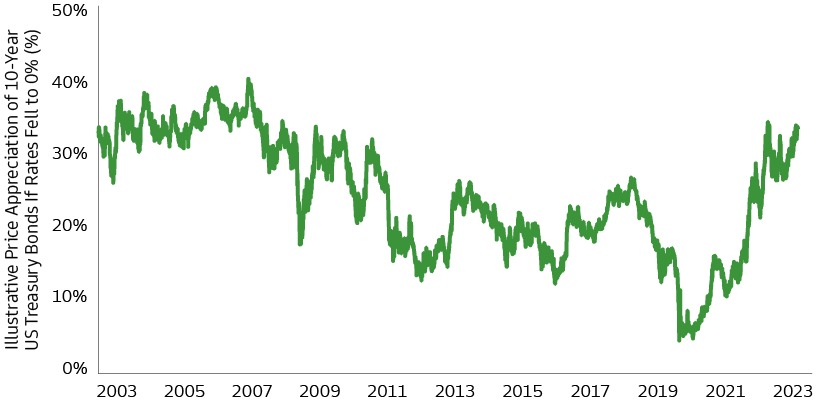
We also find that the hedging potential of intermediate-duration bonds has significantly returned. The ability of a 10-Year US Treasury Note to hedge equity drawdown risk has directly increased as yields have increased. In fact, in a scenario in which rates fall back to 0%, a 10-Year US Treasury Note could hedge 30% of an equity drawdown in a 50/50 stock/bond portfolio, all else equal, resuming its role as a “stock absorber”. Of course, this scenario is unlikely, but a material drawdown in yields is an ever-present tail risk. More importantly, it emphasizes that investors can build more risk-aware portfolios today now that yields are higher.


Source: Goldman Sachs Asset Management.

VIEW LESS DISCLOSURE
Outlook
Small Caps: Two Driving Factors

Bargain Hunting

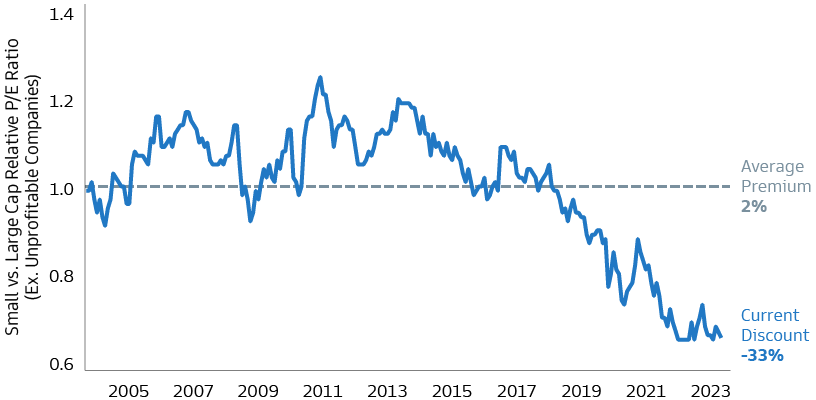
Domestic growth and valuations are the two largest drivers of small-cap equity performance, explaining roughly two-thirds of Russell 2000 Index returns in our estimate. In an environment of resilient US growth, we turn our attention to valuations, which currently screen cheap relative to expensive large-cap counterparts. Profitable companies in the Russell 2000 Index, making up roughly two-thirds of the index, currently trade at a –33% discount to the S&P 500, relative to the long-term average premium of 2%. In our view, improving US growth sentiment, alongside historically low relative valuations of cash flow-positive companies, make small-cap equities an attractive alternative to large-cap peers trading at already full valuations.


Source: FactSet and Goldman Sachs Asset Management.


Solutions
Small Caps: Considerations for a Broadening Market

Concentration Dissipation

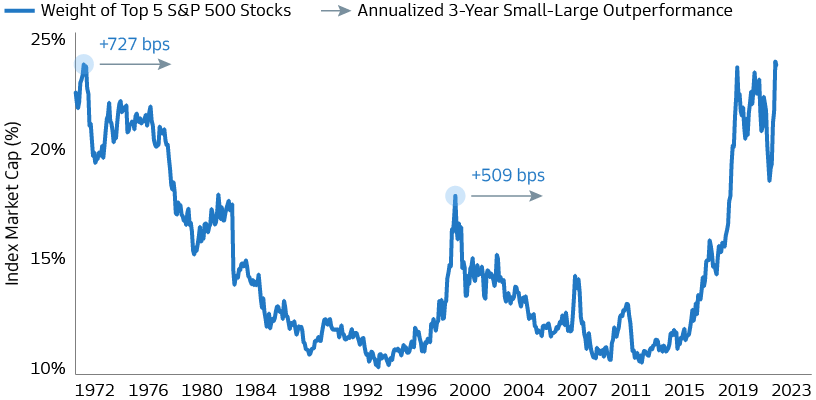
A peak in US large-cap market concentration has historically been followed by sustained small-cap outperformance. Small-cap equities are less vulnerable to a top-heavy market, helping reduce the index’s sensitivity to individual company performance. The Russell 2000 Index outperformed the S&P 500 by 727 bps and 509 bps, annually, in the three years following past periods of peak concentration in the S&P 500. Moreover, small caps tend to outperform large caps when inflation falls from high levels, as the former enjoys a much greater easing of pressure in negotiating with suppliers. Investors thinking of positioning around large-cap leaders and capturing disinflationary trends may benefit from moving down in market capitalization.


Source: Furey Research and Goldman Sachs Asset Management.

VIEW LESS DISCLOSURE
Outlook
Private Real Estate: Growth Spurt

Larger Growth Than You Might Expect

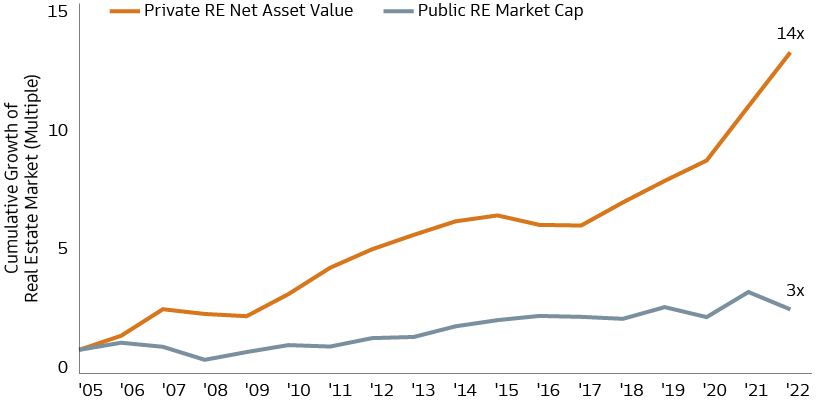
Recent stress with US regional banks, who are key lenders in commercial real estate, has led to a pullback in traditional financing. At the same time, demand for debt may continue to grow, with roughly $1.1 trillion in CRE loans due to mature before the end of 2024. This supply-demand imbalance may create an opportunity for private lenders to finance high-quality assets that previously had been capitalized by public market investors. These trends have helped drive a growth spurt in private real estate investing. Since 2020, the asset class has grown by 1.7x while the size of the public real estate market has remained flat, reflecting relatively more mature market dynamics. As such, ample opportunity exists for investors interested in private real estate to diversify investment scope beyond public markets.


Source: Bloomberg, Preqin, and Goldman Sachs Asset Management.


Solutions
Private Real Estate: Balanced Beam

A More Diversified Return Stream

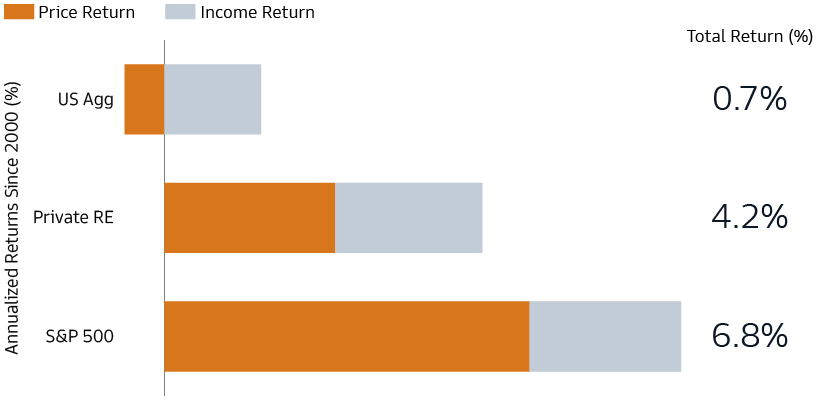
With the level of inflation above central bank target, the consideration of real estate serving as a hedge comes to play as rents re-price and existing assets appreciate in value alongside rising construction costs. Private real estate has historically demonstrated a more balanced return distribution relative to equities and fixed income, with price appreciation proving particularly strong during inflationary periods. As a result, the strategy offers potential opportunities for incremental yield, lower realized volatility, and diversification benefits. Looking ahead, we expect private real estate to outperform the S&P 500 by roughly 2pp over the next decade.


Source: Bloomberg, NCREIF, Barclays Live, and Goldman Sachs Asset Management.

VIEW LESS DISCLOSURE

Stay Informed and Be Ahead of the Curve


DOWNLOAD MARKET KNOW-HOW

Access the PDF to use with your clients

SUBSCRIBE TO MARKET KNOW-HOW

Get the latest Market Know-How delivered to your inbox as soon as it publishes

MANAGE SUBSCRIPTIONS

Related Market Strategy


CONTACT US

For More Information
Broker/Dealers
Independents/RIAs
Retirement Services
Client Service
A & C Shares
Institutional Shares