



Menu Our services in the selected location:
  • No services available for your region.
Select Location:
Remember my selection
Your browser is out of date.
MARKET KNOW-HOW 
|
1Q 2024

MARKET KNOW-HOW | 1Q 2024

Ms. Perception


The Mona Lisa is universally regarded as one of the most renowned works of art, yet one question has sparked a chasmic divide across the spectrum of art enthusiasts: is she smiling? How one perceives her expression is dictated by which cells in the retina view the image and through what neural pathway that image is transmitted to the brain. In other words, Mona Lisa’s smile, like the state of the global economy, is entirely dependent on the lens that one views it through.

Many of the world’s central banks have cooled inflation measurably without recessionary growth shocks, and a return
to respective inflation targets is possible in 2024. Still, mixed signals, such as positive earnings expectations at odds with an inverted yield curve, foster a wide dispersion of macro views. Through a balanced assessment of the full picture, we believe the hard part is over.

Importantly, our optimism around the avoidance of a global recession should not be confused with a full risk-on tilt. Rather, a balanced portfolio of equities, fixed income, and alternatives may serve as a hedge to inflation and growth risks, while maintaining robust return targets. We expect 2024 to mark the beginning of the return to a normalized investing environment.

In this edition of the Market Know-How, we explore how investors may capitalize on a resilient macro backdrop while also accounting for tail risks, with emphasis on:

  • Navigating a higher interest rate regime with balanced equity and core fixed income positioning.
  • Positioning for a potentially turbulent US election year that may feature heightened market volatility.
  • Adding the potential risk-reduction benefits of liquid alternatives while maintaining competitive return targets.

Source: Goldman Sachs Asset Management. As of November 30, 2023. “Recession” refers to a significant decline in economic activity spread across the economy, lasting more than a few months, normally visible in real GDP, real income, employment, industrial production, and wholesale-retail sales. “Inverted yield curve” refers to the spread between the 2-Year and 10-Year US Treasury yields across maturities. Diversification does not protect an investor from market risk and does not ensure a profit. There is no guarantee that objectives will be met. Views and opinions are current as of November 30, 2023, and may be subject to change. They should not be construed as investment advice. Please see additional disclosures at the end of this document.

Macro & Market Views


Global Growth

Mixed macro signals inform a wide array of global growth outlooks, though we believe some indicators command greater focus than others. Lower headline inflation and strong labor markets suggest that healthy real disposable income growth may support consumption, while a fading spending rotation from goods to services will provide a floor to manufacturing activity. On the policy side, the largest drag from monetary and fiscal tightening may have already been experienced. It has become increasingly clear that inflation progress can be achieved without material damage to labor markets.

Source: Goldman Sachs Global Investment Research and Goldman Sachs Asset Management. As of November 30, 2023. “We” refers to Goldman Sachs Asset Management. “Disinflation” refers to a reduction in the rate of inflation. “A” refers to actual. “E” refers to expected. The economic and market forecasts presented herein are for informational purposes as of the date of this document. There can be no assurance that the forecasts will be achieved. Please see additional disclosures at the end of this document. Past performance does not predict future returns and does not guarantee future results, which may vary.
Higher-for-Longer Rates: Equities – Shifting Preferences

Late Cycle Equity Investing

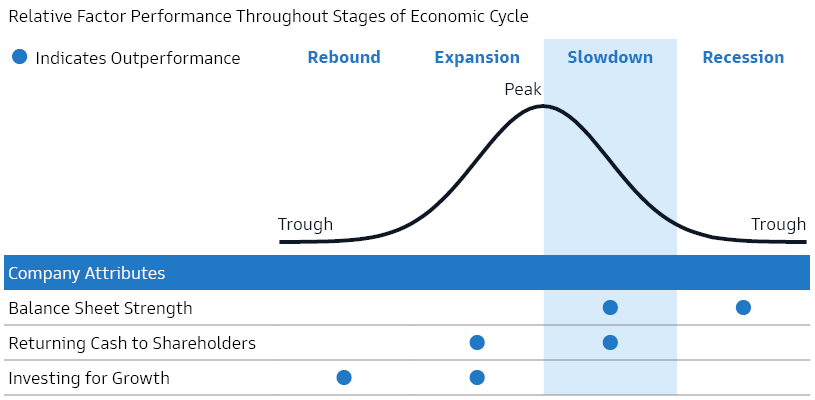
Monetary tightening in response to inflation has advanced the US into a later stage of the economic cycle, characterized by naturally slower growth. We believe this point in the cycle has much to offer equity investors, though specific company attributes should be prioritized over others. As has been experienced in the past, companies that are returning cash to shareholders in the form of dividends and share buybacks may be rewarded by investors, while those investing significantly in CAPEX and R&D may lag, as a higher discount rate undermines the attractiveness of those projects. Similarly, we believe companies with strong balance sheets, able to weather a higher cost of capital, should outperform those that depend on cheap financing.


Source: Goldman Sachs Global Investment Research and Goldman Sachs Asset Management.


Higher-for-Longer Rates: Core Fixed Income – Playing its Role

Bonds Have Come a Long Way

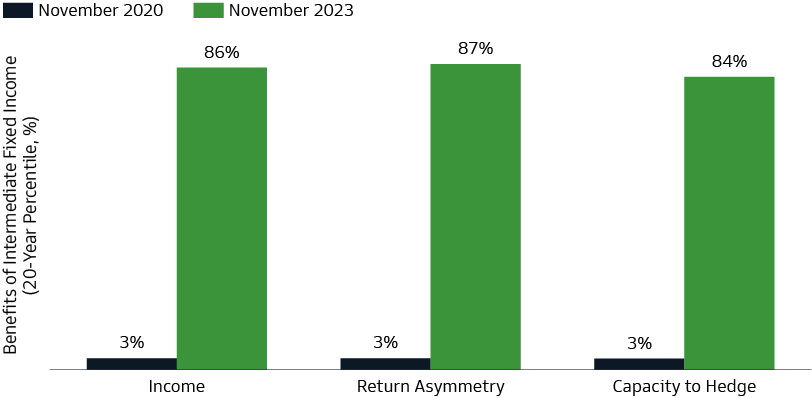
Inflation containment has broadened the opportunity set in fixed income. Across three key components—income, return asymmetry, and capacity to hedge an equity market drawdown—we find that core bonds currently play their role in a portfolio better than they have for most of the last 20 years. Specifically, a 10-Year US Treasury Note today provides better income, distribution of returns, and risk-reduction from equity volatility than it has for more than 80% of the time since 2003. Rates repricing over the last several years has hurt total returns within fixed income, but a normalized investment environment today calls for better portfolio balance. We believe core bonds are well-situated to provide that balance.


Source: Bloomberg and Goldman Sachs Asset Management.

VIEW LESS DISCLOSURE
US Politics: Grinding Gears

Wide Divide

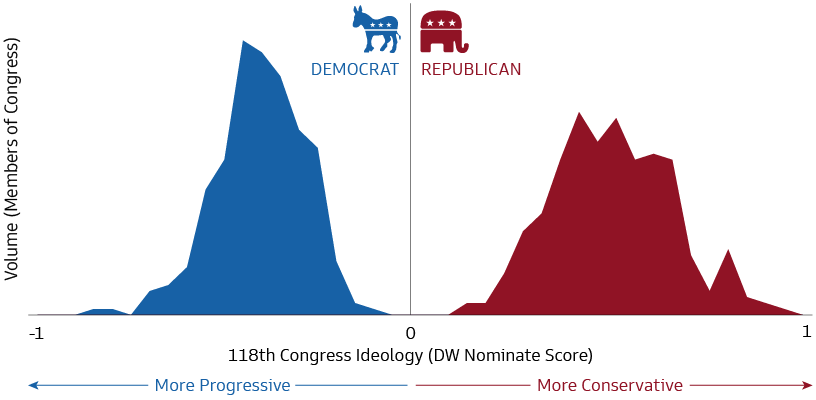
Over time, we have seen a steady decline in the output of enacted legislation in the US. This decline, in part, has been attributed to shrinking levels of ideological overlap between parties, but it is also due to increased dispersion on an intra-party basis. The combination of these two factors, along with increasingly narrow majorities in both the House and Senate, creates an environment in which a few dissenters can impede legislative progress. We may not know what the US government will look like in the coming years, but we feel confident that stalemates and brinkmanship have become embedded into lawmaking and governing, and we may see periodic volatility in US markets in conjunction with future political deadlocks.


Source: Vote View and Goldman Sachs Asset Management.


US Politics: Party Foul

Interesting, but Statistically Insignificant

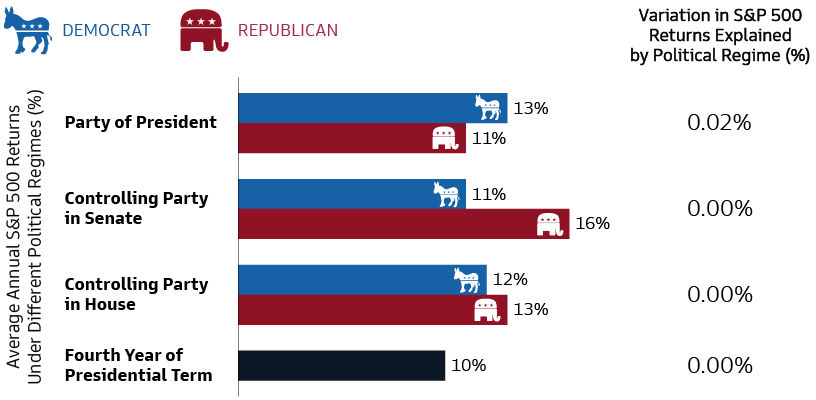
Although elections and shifts in power tend to dominate headlines, we believe that investors need not adjust their risk profiles solely based on the outcome of the 2024 US election. Historically, S&P 500 performance under different political regimes is comparable, and the proportion of those returns explained by the political party in power is statistically insignificant. To be sure, the policies implemented by elected officials are important, especially with the next administration responsible for addressing expiring provisions in the Tax Cuts and Jobs Act. However, across the entire ballot, we do not believe there is enough historical evidence to support investors voting with their portfolios rather than their personal and political beliefs.


Source: Bloomberg, Goldman Sachs Global Investment Research, and Goldman Sachs Asset Management.

VIEW LESS DISCLOSURE
Liquid Alternatives: Drifting Apart

Shifting Relationships

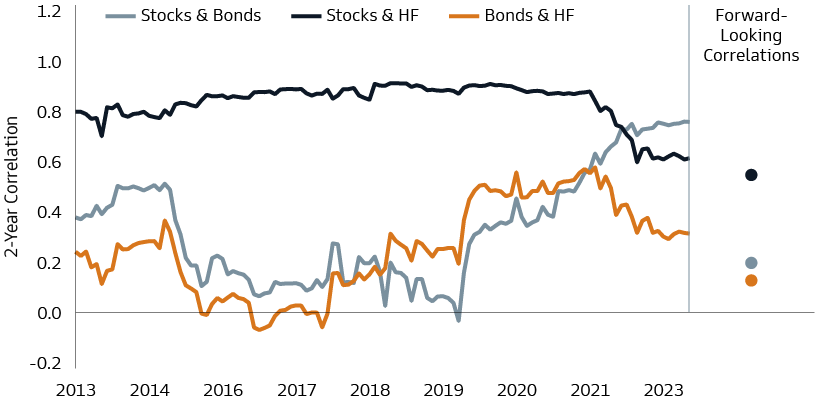
As the interest rate landscape has changed, so have the relationships between asset classes. Over the past two years, the correlations between 1) stocks and hedge funds and 2) bonds and hedge funds have decreased considerably, reflecting opportunity for further portfolio diversification through liquid alternatives. We expect these trends to continue, allowing for more efficient portfolio design. Additionally, we believe return prospects have improved among hedge fund managers, as higher rates create more disperse markets and increase interest income on the cash proceeds from selling borrowed shares.


Source: Bloomberg, Goldman Sachs Multi-Asset Solutions, and Goldman Sachs Asset Management.


Liquid Alternatives: Rethinking Risk Profiles

Potential Benefit from Further Diversification

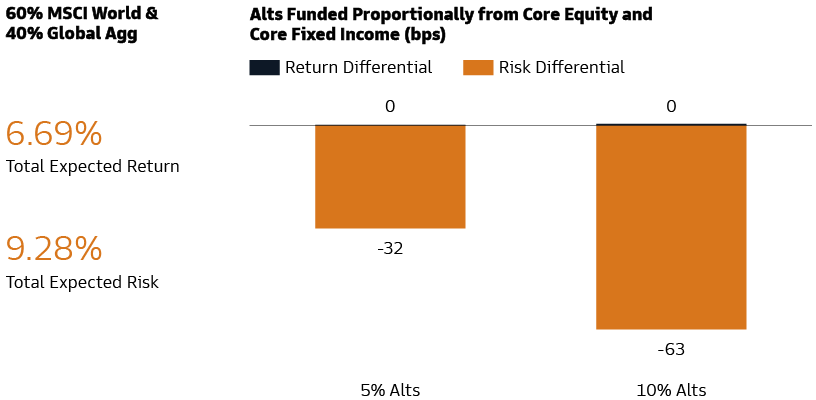
Liquid alternatives can often enable lower portfolio volatility without compromising returns, in our view. Just a 5% portfolio allocation to liquid alternatives lowers total expected volatility by –32 bps, while a 10% allocation lowers total expected volatility by –63 bps. Despite the reduction of risk, these allocations may not diminish portfolio return potential, with forward-looking return estimates virtually unchanged by the addition of this diversifying asset class. If the last few years were characterized by outsized overweights to asset classes such as equities and cash, we believe 2024 will be characterized by well-designed, balanced portfolios.


Source: Goldman Sachs Multi-Asset Solutions and Goldman Sachs Asset Management.

VIEW LESS DISCLOSURE

Stay Informed and Be Ahead of the Curve


DOWNLOAD MARKET KNOW-HOW

Access the PDF to use with your clients

SUBSCRIBE TO MARKET KNOW-HOW

Get the latest Market Know-How delivered to your inbox as soon as it publishes

MANAGE SUBSCRIPTIONS

Related Market Strategy


CONTACT US

For More Information
Broker/Dealers
Independents/RIAs
Retirement Services
Client Service
A & C Shares
Institutional Shares